The invisible tax of organizational immaturity
 Rolf Schutten
- 23 Jul, 2026
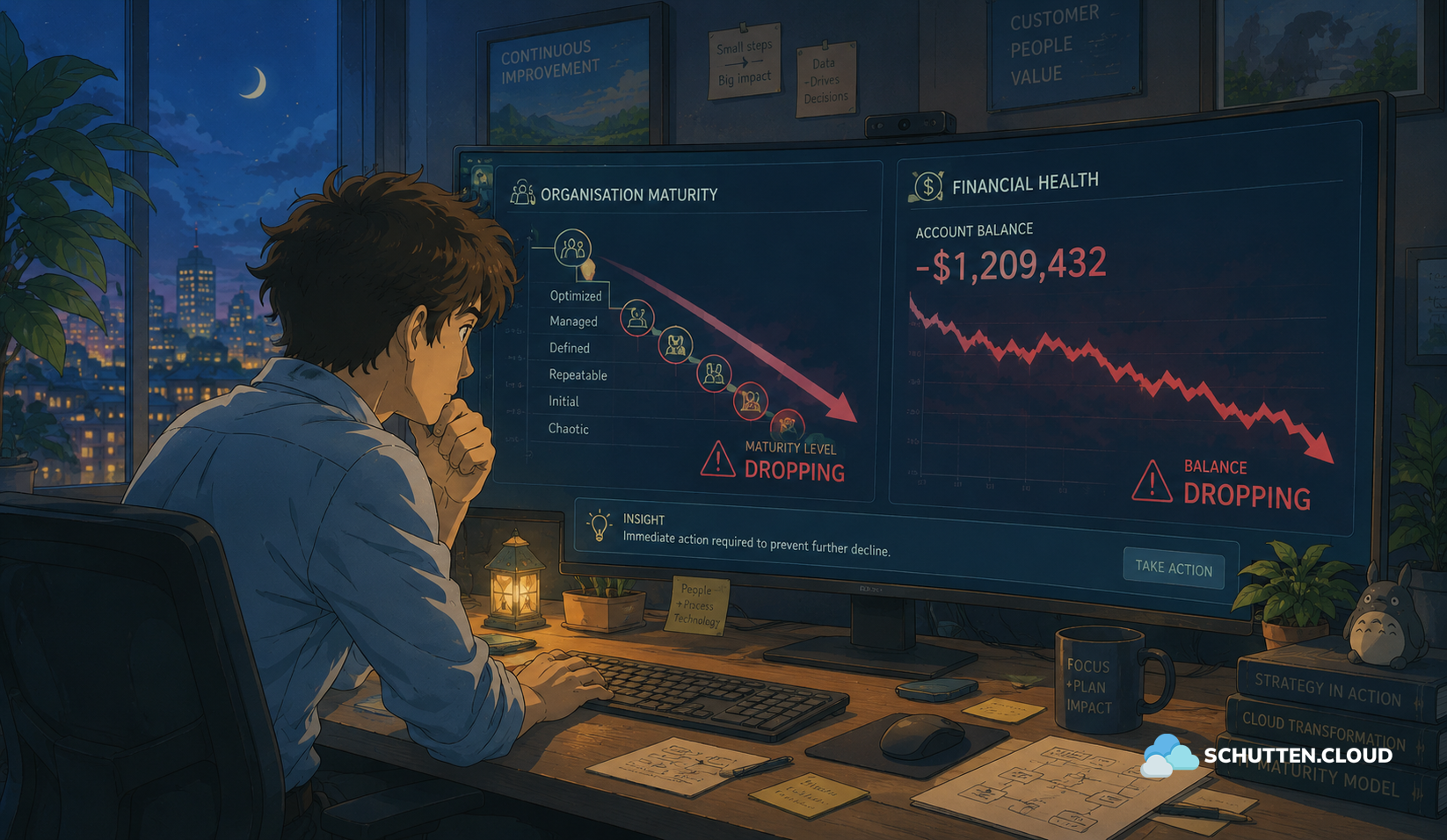
When organizations talk about costs, the conversation usually revolves around salaries. Or around software licenses, cloud consumption. Office space even, or procurement. Those costs are easy to measure. They appear neatly on financial statements. But after working with organizations of different sizes and maturity levels, I’ve become convinced there’s another cost almost nobody measures.
An invisible tax.
One that quietly drains productivity, frustrates employees and slows decision-making. Not because people aren’t working hard. But because the organization itself creates friction.
Everyone is busy. Few people are moving forward.
One of the first things I pay attention to when joining an organization isn’t the technology. It isn’t the financial performance. It isn’t even the organizational chart.
I watch how people work. How decisions are made. How priorities change. How meetings end. How often people say things like:
- “We’re waiting.”
- “Nobody knows who’s responsible.”
- “We’ll discuss it again next week.”
- “I assumed someone else was taking care of it.”
Those sentences rarely point to individual performance. They point to organizational design. Because mature organizations don’t become productive by hiring smarter people. They become productive by reducing unnecessary friction.
The tax nobody budgets for
Organizational immaturity doesn’t usually appear as one dramatic failure. It appears as thousands of tiny inefficiencies. Like a meeting without decisions. An action without an owner. A priority that changes three times in one week. An approval that waits in someone’s inbox. A project delayed because two departments assumed the other was responsible.
Individually, none of those events seem particularly significant. Collectively, they become incredibly expensive. Not because they cost money directly. Because they consume something even more valuable: Leadership capacity. Attention. Momentum.
Friction compounds
Recently I observed an organization working through several operational challenges at the same time. None of them were catastrophic. A leadership transition. A supplier decision waiting for approval. Priorities shifting as new information became available. Teams adjusting schedules to respond to unexpected developments.
Every individual situation was understandable. What interested me wasn’t the incidents themselves. It was how much organizational energy disappeared into coordinating them. People weren’t solving customer problems. They were reorganizing calendars. Clarifying responsibilities. Following up on decisions. Waiting for answers.
Every interruption looked small. Together, they formed a pattern. The organization wasn’t paying for the incidents. It was paying for the friction between them.
Activity is not progress
Immature organizations often look incredibly busy. Calendars are full. Teams work hard. Everyone feels under pressure. From the outside, it almost looks impressive.
Until you ask a few simple questions:
- What are our three most important priorities this quarter?
- Which KPI tells us whether we’re improving?
- Who owns this decision?
- What happens if nothing changes?
Surprisingly often, the answers become vague. Because activity is easy to observe. Progress requires clarity. And clarity requires leadership.
The hidden cost of ambiguity
Ambiguity is one of the most underestimated operational costs I know.
If priorities are unclear… People create their own.
If ownership is unclear… People wait.
If success is undefined… Everyone believes they’re doing the right thing.
The irony is that highly capable people become less effective, not because they lack competence, but because they’re forced to spend their energy navigating uncertainty instead of creating value. Organizations don’t lose momentum because employees suddenly become less talented. They lose momentum because ambiguity quietly taxes every decision.
Every interruption has a cost
One unexpected meeting. One rescheduled customer visit. One delayed approval. One forgotten follow-up. One unclear decision. Individually, they’re almost invisible. But organizations rarely suffer from one interruption. They suffer from hundreds.
Every context switch costs attention. Every unclear responsibility creates another conversation. Every missing KPI creates another opinion. Every delayed decision creates another dependency. Eventually, the organization becomes extremely busy managing itself. Instead of serving customers.
Maturity isn’t about perfection
No organization operates without surprises. Nor should it. Markets change. Customers change. People leave. Plans evolve. Operational maturity isn’t the absence of unexpected events. It’s the ability to absorb them without disrupting everything else.
The most mature organizations I’ve worked with weren’t necessarily the most structured. They were the most predictable. People knew who decided. People knew what mattered. People knew what success looked like. That predictability creates an enormous competitive advantage. Because it allows talented people to focus on solving meaningful problems instead of organizational ones.
The role of leadership
This is why I believe organizational maturity is fundamentally a leadership responsibility. Not because leaders should solve every problem. But because leaders design the environment in which problems are solved.
Good leaders don’t simply remove obstacles. They remove recurring obstacles. They don’t fix today’s confusion. They redesign tomorrow’s process. They don’t celebrate people who constantly save the day. They build organizations that need fewer heroes.
Because every recurring operational problem is usually trying to tell you something. Not about the people. About the system.
Closing thought
The most expensive organizations aren’t always the ones with the highest payroll. Sometimes they’re the ones quietly paying an invisible tax every single day. A tax on attention. A tax on momentum. A tax on decision-making. A tax on leadership.
Most organizations never notice it because they experience it gradually. It simply becomes “the way we work.” But it doesn’t have to be. Because organizational maturity isn’t measured by how hard people work. It’s measured by how little unnecessary friction they have to overcome before they can do their best work.