Showing Posts From
Governance

 Rolf Schutten
- 04 Sep, 2026
The honest truth about digital sovereignty: why control is a spectrum
A few years ago, corporate IT was simple. Want to build a flexible, fast organization? The answer was straightforward: move everything to the cloud. Companies shut down server rooms, sold their hardware, and handed the keys to big Tech. It felt great. No more failing hard drives or midnight cooling emergencies. Now, boardrooms are changing their minds. That hands-off cloud strategy isn't looking so smart anymore. Today, one question keeps coming up in every strategy meeting: who actually owns our digital setup? Digital sovereignty sounds like a fancy word. Tech sales reps will tell you it's just a new license or a server placed in a local data center. That's taking the easy way out. The real story is harder. Sovereignty isn't a badge you buy, and it isn't a light switch you flip between safe and unsafe. It's a continuous trade-off between control, risk, and speed. What real digital sovereignty means To grasp digital sovereignty, look at how countries operate. A sovereign nation makes its own rules. It guards its borders and sets its own course without taking orders from neighbors. Digital systems work the same way. Real sovereignty means your organization stays in charge. You know where your files sit, who can open them, and what runs in the background. Most importantly, it means you can walk away. If your provider jacks up prices or gets caught in a foreign political storm, you can pack up your data and move without collapsing your business. People often mix up security and sovereignty. They overlap, but they aren't the same. Security keeps hackers out. Sovereignty keeps your cloud vendor—and foreign courts—from pulling the strings. Security asks: "Are thieves breaking in?" Sovereignty asks: "Can the landlord lock me out tomorrow?" Four reasons control is back on the agenda This sudden focus on sovereignty didn't happen in a vacuum. Four pressure points brought it to the surface. 1. Clashing privacy laws European rules demand strict protection for personal data. The baseline is simple: European data follows European law. Yet the dominant cloud platforms operate out of the US, bound by American regulations. This creates a mess. Laws like the US CLOUD Act can force tech firms to turn over files during investigations, regardless of where the physical server sits. That leaves European firms stranded in a legal gray zone. Which law wins out? That uncertainty is pushing banks, hospitals, and governments to demand firm guarantees. 2. Shifting world politics Global tech used to feel seamless and borderless. That phase is over. Today, software and servers are caught right in the middle of trade spats and international conflicts. Relying entirely on foreign infrastructure is a real risk. If relations sour, critical systems like energy grids, healthcare, or payments could go dark overnight. At the same time, physical local servers carry their own risks. During a conflict, an on-premise data center can be destroyed. A global cloud network might be the only thing keeping the data alive. Sovereignty isn't about hiding in your local basement; it's about choosing the safest location for your specific situation. 3. The trap of vendor lock-in Building an entire IT landscape on proprietary cloud tools locks you in tight. Migration becomes a nightmare. When a provider raises subscription fees or drops support for software you rely on, you're stuck. You pay up because leaving costs too much time and money. Sovereign planning avoids this trap by keeping systems portable. 4. The push into artificial intelligence Companies are rushing to adopt AI. Everyone wants faster automation and better analytics. AI brings a huge catch. Feeding proprietary data into outside algorithms opens a can of worms. Where do those prompts go? Is your corporate secret being used to train a model for your competitors? If you don't control the platform, you don't control your intellectual property. Control is a spectrum, not a binary choice There is no single "sovereign" tech setup. The right choice depends on what a system actually does.Position on spectrum Infrastructure type Level of sovereignty Operational trade-offs Key characteristicsFar Left Public Cloud Low Low control, maximum flexibility High scalability, low entry cost, rapid featuresMiddle Left Governed Public Cloud Medium-Low Policy-bound, high flexibility Standard cloud wrapped in strict security rulesCenter Encrypted Hyperscale Medium Strong technical boundaries You hold the encryption keys and access logsMiddle Right Regional Partner Cloud Medium-High Local legal jurisdiction Managed locally, tailored for regional complianceFar Right Isolated On-Premise High Full ownership, low flexibility Servers in your building, slow to expandPublic Cloud: Great for public websites and marketing tools. Fast, cheap, and easy to scale. Encrypted Cloud: Useful for business operations. You get cloud scale, but keep the decryption keys to yourself. Regional Clouds: Useful when strict local laws apply. Run by local vendors, though you lose access to some cutting-edge cloud features. Isolated On-Premise: Reserved for core secrets or critical infrastructure. Total control, but expensive and slow to change.The limits of total control Frameworks like the European Cloud Sovereignty model try to standardize these levels using SEAL metrics (Security, Transparency, Autonomy, Legal). They help teams move past sales pitches and measure actual security. Don't expect perfection, though. 100% digital independence is a pipe dream. Microchips come from global supply chains. Firmware comes from overseas. System software relies on international code bases. No company or country operates entirely on its own island. Practical sovereignty isn't about total isolation; it's about managing dependencies smartly. What hyperscalers are actually offering Global cloud providers know customers are uneasy. To keep big accounts, they now sell sovereign cloud features. Don't confuse this with a separate, private internet. These features are built directly on top of public infrastructure. They offer governance tools, strict access controls, and custom encryption options.Architectural layer Responsible party Main functional componentsGovernance & Control Layer Customer / Organization Your encryption keys, automated policies, access approvals, audit logsUnderlying Infrastructure Layer Cloud Provider Data center buildings, network cables, physical servers, power gridsStoring data locally isn't enough A server located down the street gives a false sense of security. Local storage helps with network speed and meets basic residency rules. It doesn't stop foreign warrants or rogue admin accounts, though. True sovereignty relies on technical boundaries, not postal codes. Let math do the heavy lifting Customer-managed encryption is your best defense. Encrypted files look like gibberish without the key. Standard setups let the cloud vendor hold the keys. In a sovereign setup, you manage the keys in your own key vault. If a third party demands access to your data, the provider can only hand over scrambled files. Cryptography protects you when contracts fall short. Setting strict boundaries Sovereign setups block unauthorized access. With tools like Customer Lockbox, vendor engineers can't touch your systems without your direct approval. Everything leaves a trail. Immutable log files record every action, giving you proof for auditors that your files stayed untouched. Managing AI without leaking data Running AI safely takes clear boundaries. Letting staff paste internal documents into free public chatbots is a recipe for disaster. Keep AI inside protected enterprise tenants. This isolates your data from the outside world.Environment stage Data handling rule Security outcomeData Ingestion Internal databases stay behind your firewall Sensitive data stays hidden from public viewProcessing & Inference Private AI models run inside your secured tenant Prompts and responses remain strictly privateModel Retraining External training feedback loops are turned off Corporate knowledge never leaks to outsidersTechnology alone won't save you from messy file habits, though. If your internal access rules are sloppy, an AI tool will just expose those files faster. Fix permissions before turning on smart features. Practical steps to take back control Regaining control isn't about tearing down your IT setup. Take a structured approach.Sort your data: Figure out what you actually store. Public pages don't need maximum security, but customer records do. Know your risks: Decide what hurts worse: a temporary outage or a leaked database. Match your defenses to real impact. Mix your setups: Put general tools in the public cloud. Move sensitive records to encrypted layers or private platforms. Hold your own keys: Manage encryption keys yourself for all sensitive cloud files. Avoid proprietary traps: Build on open-source standards and standard APIs. Staying flexible makes migrating possible if things go sideways.Traditional cloud vs. Modern sovereign strategy The way we build systems has fundamentally changed over the past decade.Strategic dimension Traditional cloud strategy Modern sovereign strategyPrimary goal Maximum speed, low cost, easy scaling Risk control, compliance, long-term autonomyTrust model Provider contracts and verbal promises Math, encryption keys, and unalterable logsData location Wherever hosting is cheapest Strict legal and geographical boundariesVendor reliance Deep integration into single platforms Flexible architecture using open standardsAccess rules Vendor manages system access You approve and track every support requestFinal thoughts The era of trusting cloud providers blindly is over. Moving files to a central platform doesn't mean your work is done. With shifting laws, volatile politics, and fast-moving AI tools, taking charge of your data is mandatory. You don't need to pull the plug on the public cloud. You just need to be a smarter customer. Know what you own, hold your encryption keys, and keep your options open. Real digital sovereignty isn't about building an isolated fortress. It's about making sure you always hold the keys to your own house.

- Rolf Schutten
- 25 Aug, 2026
Seeing opportunities with AI
Artificial Intelligence (AI) is changing the way businesses operate, offering new opportunities and challenges. As a C-level executive, it's important to understand how AI can benefit your company while managing the risks involved. Setting Your AI Goals First, you need to decide what you want to achieve with AI. Do you want to use it to improve internal processes or to create new products and services? Your ambition will guide your strategy and set realistic goals. For example, AI can help streamline back-office tasks, making them faster and more efficient. Or, you might use AI to offer personalized customer experiences, which can lead to higher customer satisfaction and loyalty. Choosing the Right Approach Next, consider how you will implement AI. There are different ways to do this. You can use pre-built AI tools that are already available. This is quick and doesn’t require much technical knowledge, but it may not fit your specific needs perfectly. Alternatively, you can adapt existing models with your own data to make them more tailored to your business. This approach is more flexible but requires more expertise. Lastly, you can develop your own AI system from scratch. This gives you full control but is more expensive and time-consuming. Choosing the right path is crucial. It affects how quickly you can start using AI and how much it will cost. For instance, if your goal is to quickly improve customer service, a pre-built solution might be the best choice. If you need a highly customized solution for a specific problem, developing your own AI system might be necessary. Navigating the Risks Using AI also comes with risks. These include unreliable outputs, data privacy issues, cyber threats, and regulatory concerns. For example, AI systems can sometimes produce incorrect or unexpected results. This can happen if the data used to train the AI is flawed or if the system encounters new situations it hasn’t seen before. Ensuring data privacy is crucial, especially when handling sensitive information. You need to comply with regulations like GDPR in Europe or HIPAA in the U.S. Cyber threats are also a concern. AI systems can be targeted by hackers, putting your data at risk. This means you need to have robust cybersecurity measures in place. Additionally, different countries have different rules about AI, and you need to follow them. This can be complex, as regulations can change quickly and vary widely. For instance, regular audits and compliance checks can help ensure you stay within legal boundaries. Leading with Vision and Prudence Leading with AI requires a balanced approach. You need to support innovation while also ensuring safety and ethical considerations. This involves engaging stakeholders, balancing speed and caution, and fostering a culture of learning. Engaging stakeholders means talking to everyone involved, from developers to end-users, to get their input and support. This helps build a sense of ownership and alignment. Balancing speed and caution is also important. You need to move fast to stay ahead of competitors but take time to ensure your AI is reliable and secure. Fostering a culture of learning means encouraging your team to learn about AI and keep up with new developments. This helps keep your organization ahead of the curve. Wrapping Up AI offers a unique chance for C-level executives to drive growth and innovation. However, it also presents significant challenges. By carefully planning and managing risks, you can use AI to improve your business and stay ahead of the competition. In summary, leading with AI means setting clear goals, choosing the right deployment strategy, and being prepared for risks. With the right approach, you can unlock the full potential of AI for your organization. True leadership means guiding your company through the complexities of AI with vision and resilience.

- Rolf Schutten
- 23 Aug, 2026
Governing AI agents while driving business value
Technology leaders today face a very difficult choice. On one hand, company executives want to see clear financial results from artificial intelligence investments. On the other hand, using automated AI tools introduces safety and security risks that older systems never had. To handle this successfully, companies must move away from simple testing and focus on clear rules, cost control, and practical learning. Higher pressure on budgets and financial results For a few years, many companies spent money on AI just to see what it could do. Today, that period of open spending is over because business leaders want to see real value. While many companies are still spending more money on technology, only a small number expect to get fast returns on their AI investments. This gap between spending and real results puts a lot of pressure on technology directors. To solve this, successful companies are changing their approach in three main ways:Focusing on clear tasks: Leaders are stopping general pilot projects that have no clear goals and are choosing tasks where results are easy to measure. Setting goals before starting: Good teams decide on clear targets before launching a project, so they can prove the financial benefits later. Managing hidden costs: Using AI models too much, paying high usage fees, and running uncontrolled software tools can quickly become too expensive.The hidden risks of automated software tools The step from standard AI models to automated AI agents creates new risks for companies. Standard tools just answer questions, but automated agents can run code, change databases, and complete complex actions across different systems by themselves. If these systems operate without strict rules, they can make unexpected mistakes, like accidentally deleting important company databases. At the same time, many employees are using unapproved AI tools on their own. Workers in different departments often use personal accounts or free online tools to do their jobs faster. While this can save time, it can also leak private company information and create serious security problems. Changing safety rules from yearly checks to daily monitoring Old ways of managing software risks, such as checking rules once a year, do not work for fast AI systems. Because automated tools work continuously and very quickly, security plans must adapt to monitor them all the time. To keep systems safe without stopping work, technology managers should follow a clear plan:Limiting system access: Automated tools should never have full access to everything; their permissions must match the exact task they are doing. Creating strong central rules: Instead of changing safety settings for every new tool, create one strong system that decides what data can be used and when a human must check the work. Keeping complete activity logs: Every action taken by an automated tool must be saved in a list so managers know what happened and why.** Giving clear responsibility to staff: Set up mixed teams and clear ownership so that technology, legal rules, and business goals work together.Helping employees learn and adapt As software work becomes more automated, companies face a new human problem. Younger workers and junior developers who rely too much on AI tools might not learn basic building skills. If they do not learn from real mistakes, it becomes hard for them to notice when an AI system gives a wrong answer. To fix this problem, business leaders need to build a learning culture. Experienced staff members should guide younger workers, encourage open discussions about technical issues, and check AI outputs carefully. Good training across the whole business helps everyone understand both the power and the limits of these new tools Closing thoughts Navigating the complex world of modern technology requires both fast innovation and careful control. Successful leaders will not be the ones who buy every new tool, but those who build clear safety rules, manage spending carefully, and stay responsible for their automated systems. True progress in technology happens when we combine speed with total responsibility.

- Rolf Schutten
- 22 Aug, 2026
Mastering inner leadership
Effective leadership does not begin with managing teams, setting strategy, or optimizing processes; it starts with mastering your own mindset. To navigate complex environments, leaders must move beyond quick automatic reactions and cultivate a deep level of self-awareness. Understanding your inner sabotage Every leader carries hidden patterns that quietly influence decisions. Under intense pressure, these automatic triggers take control. We often mistake our immediate emotional impulses for logical thinking. In reality, these impulses usually stem from fear, ego, too much empathy, or a need for complete control. Recognizing that your initial reaction is rarely your best response is the foundational step toward true authority. When you stop acting on instinct alone, you gain the clarity required to lead effectively. Thinking in loops and balancing opposites When pressure mounts, standard linear thinking pushes leaders toward rapid, binary choices: problem versus solution, yes versus no. Real growth happens when we adopt continuous loop thinking, recognizing that opposing forces exist together and can balance each other out. Instead of fighting difficult emotions or impulses, effective leaders invite their natural counterparts to restore harmony:Anger and forgiveness: Uncontrolled anger drains energy, whereas choosing forgiveness restores focus, reduces conflict, and creates emotional clarity. Pride and humility: An inflated ego creates organizational blind spots, while conscious humility keeps leaders grounded and open to learning. Jealousy and self-worth: Comparing performance to others breeds insecurity, but leaning into core values builds authentic confidence. Greed and generosity: The urge to hoard control or credit weakens trust, while generosity creates shared success and stronger teams.The power of paradoxical action Understanding internal dynamics is important, but true leadership mastery shows up in your actions under pressure. Leaders often fall into predictable behavioral traps driven by immediate instincts. Breaking these habits requires practicing paradoxical action: stepping out when your instinct tells you to step in, and stepping in when your instinct tells you to step out. When pride or frustration urges you to intervene immediately, dominate a situation, or enforce total control, that is your signal to step out, observe, and create space. Conversely, when uncertainty or discomfort makes you want to avoid a crucial conversation or delay a tough decision, that is your precise cue to step in and lead. Building long-term emotional agility Self-mastery is not a one-time decision; it is a continuous daily habit. By observing your reactions without judgment, you create a vital pause between emotion and action. Over time, this deliberate practice transforms leadership from a series of stressful stress-responses into a calm, intentional art. Closing thoughts Great leaders are not defined by their initial emotional impulses, but by how they choose to respond to them. By breaking automatic patterns and balancing internal forces, you unlock genuine emotional agility and strong personal authority. True leadership begins when you master the courage to step back from reaction and step into responsibility.

- Rolf Schutten
- 21 Aug, 2026
Stop wasting time on the scenic route to success
A manager once gave me a long speech about how success is a slow journey. He used the metaphor of a road trip: driving from Amsterdam through Cologne, relaxing in Austria, enjoying good food, and eventually reaching Rome. He told me that every leader needs to enjoy the ride. My response was simple: "If the goal is to enjoy a road trip, that makes sense. But if the goal is to get to Rome as fast as possible, I am going to Schiphol Airport to catch a plane. I can eat good food and relax when I get there." Too often, I hear leaders say that things "just take time." But every leader should ask themselves an honest question: is this really taking time, or are you just letting time pass? The trap of enjoying the journey too much There are many managers and directors who make a comfortable living taking the slow road. They love the discussions, the endless process, and the feeling of moving forward without the pressure of actual results. They are happy, well-paid, and comfortable. However, using "the journey" as an excuse often hides a lack of ambition or execution. When leaders focus too much on the process, they confuse activity with achievement. Enjoying the ride is fine, but as a leader, your primary responsibility is still to reach the destination. From zero to hero in three years I know how powerful human potential is when you combine a clear goal with discipline. Years ago, after several frustrating client conversations, I decided to leave service management and move into presales and architecture. At that point, I had never even opened the Azure portal. Instead of taking years to figure it out slowly, I set a clear target. Every evening, I studied in my attic room. I stayed curious, learned relentlessly, and built a network of experts who were willing to help me. In less than three years, I went from knowing nothing about Azure to becoming a Microsoft MVP and a senior solutions architect. It happened because I refused to accept anything less than my target. I did not wait for time to pass; I made time work for me. Taking control of your health with the same discipline I applied this exact same mindset when my health was at risk. My children wanted me to stop smoking, and after suffering a second collapsed lung before a major operation, I knew I had to make a drastic change. I stopped smoking completely. Today, I train in the gym four days a week, play padel with friends, eat healthy, avoid weekday alcohol, and deal with stress immediately instead of keeping it in my body. I prioritized myself so that I could be strong enough to support others. Once again, it was not about waiting for a slow transformation. It was not about making small, simple changes. It was about making a firm decision and following it up with daily discipline. Most people underestimate their own power Most leaders and teams severely underestimate what they can achieve. Although they overestimate what you can achieve in a few weeks, they underestimate what discipline can do for you in a few months. Consistency is key. Most leaders think big changes require endless time, so they move at a comfortable pace. But with real ambition, clear focus, and relentless discipline, you can achieve in months what takes others years. It is completely fine if some people prefer the long, scenic route. But you do not have to slow down for them. Set your goal, board the plane, and leave the slow movers behind. You'll meet them in Rome later. Closing thoughts Success is not an accident, and time is not an excuse. While others spend years talking about the journey, you have the power to define your destination and fly straight to it. Focus on what you want, build the discipline to get it, and never let comfortable people dictate your pace. True leadership is not about enjoying a slow ride, but about having the discipline to reach your destination at your own pace.

- Rolf Schutten
- 20 Aug, 2026
Why leaders shouldn't give weight to every battle
As a leader, you are constantly surrounded by information, conflicts, opinions, and unexpected events. It feels natural to address everything that lands on your plate. However, there is a fundamental rule in leadership that many overlook: your reaction creates reality. When you choose to respond to a situation, you publicly give it weight. You acknowledge that it is real, important, and worthy of attention. But what happens when you react to the wrong things? Understanding when to step into the ring and when to pretend you didn't see a thing is one of the most critical skills a leader can master. The hidden danger of acknowledging everything It is tempting to believe that a good leader handles every problem directly. But acknowledging every minor conflict, provocation, or mistake can backfire quickly. When you validate every issue by responding to it, two things happen:You give up your power: If you constantly react to what others do or say, you let them set your agenda. You become reactive instead of strategic. You risk looking weak or submissive: Formally acknowledging minor politics or small attacks can make you look defensive. It shows that those small things can easily disturb you.If you react to every small distraction, you erode your own authority and mandate. You waste precious energy on noise instead of focusing on long-term impact. When to "play dumb" Sometimes, the most powerful response is no response at all. In management, choosing not to see or hear something—turning a blind eye—can be a strong tactical move.It starves negative energy: Small drama and minor provocations rely on oxygen. If you don't give them attention, they usually fade away on their own. It preserves focus: Your team watches what you pay attention to. If you focus on small details, they will too. If you ignore the noise, they stay focused on the real work. It maintains your position: By ignoring trivial issues, you signal that certain low-level behavior is simply beneath your level of engagement.Act or ignore? Before you jump into action, ask yourself these three filtering questions: 1. Does this threaten our core values or strategic goals? If a situation directly harms team safety, ethics, or main targets, you must act firmly and immediately. Leaving these issues unaddressed damages your credibility. 2. Am I reacting out of ego or true necessity? If someone makes a light remark or questions your stance, ask yourself if your ego is just feeling hurt. If there is no real impact on the business, let it go. 3. Will my reaction solve the problem or just amplify it? Sometimes, bringing an issue into the spotlight creates a bigger crisis than the original problem. If acknowledging an event makes your position weaker or subordinate, step back. Protecting your mandate and authority Leadership is not about fighting every battle; it is about choosing which battles are worth winning. When you are selective with your energy, your team learns that when you do speak or act, it truly matters. By refusing to acknowledge small, distracting realities, you protect your authority and stay in control of the narrative. Closing Thoughts Mastering the balance between action and silence takes practice. Acknowledge what builds your team and advances your mission. Ignore the noise that drags you into petty politics. Your authority does not come from controlling every detail, but from directing your focus toward what truly lasts. True authority is not shown by responding to everything, but by choosing what truly deserves your energy.

- Rolf Schutten
- 19 Aug, 2026
Why saying 'no' is the only sustainable choice
Many operational leaders recognize this scenario: you return from vacation and discover that important decisions were made informally over coffee. Official rules were ignored, and there is no proper handover. Suddenly, an urgent executive presentation lands on your desk with a 48-hour deadline. Your first instinct is likely to work overtime and clean up the mess. It feels helpful, useful, and necessary. However, stepping in to fix everything is the worst thing you can do. Leadership expert Bas Kodden explains in his book The Devil Inside that you end up sabotaging yourself and your organization. When you solve problems caused by poor leadership, you hide the real damage of broken agreements and keep the chaos alive. To build a healthy organization, you must face the truth: you have to stop helping. The trap of self-sabotage Why is it so hard to say "no"? Why is our default reaction always a stressed "yes"? It comes down to internal "saboteurs" or emotional triggers:Fear: Fear of conflict, fear of appearing unhelpful, or fear that everything will fall apart if you do not step in. Empathy: Excessive sympathy for desperate colleagues, which causes you to take on their pressure and stress. Ego: The desire to be the hero who saves the day, or the fear of feeling guilty.Because of these triggers, we constantly compensate for broken processes. True leadership starts with self-leadership: leading yourself first. You need to reflect on these emotional traps and stop making excuses for poor planning. Why "no" is the most sustainable choice Saying "no" to artificial urgency is not selfish or unhelpful. It is the most sustainable choice for your team and organization. When you decline an unplanned request, three positive things happen:The problem stays with the owner: The person who ignored rules or failed to plan feels the direct consequences, which encourages better behavior next time. You protect your team: You save your team's energy and capacity for planned operational goals. Governance is restored: Declining informal requests forces managers to use official decision-making channels.7 Rules for operational boundaries Saying "no" requires self-control. Use these seven practical rules to evaluate last-minute requests:No goal means "no": If the request does not directly support agreed goals, it is not a priority. Urgent is not always important: Someone else's panic usually means poor planning. Do not make it your problem. Look at hidden costs: Every extra task takes time. Ask yourself: Which important goal must I sacrifice for this? Saying "yes" to chaos means saying "no" to strategy: Time is limited. Last-minute work always hurts the quality of your core duties. Take time to pause: Stop reacting automatically. Take a moment to think before giving a clear answer. Let your calendar decide: If the task does not fit into your schedule, the calendar makes the decision for you. Demand context first: Ask for the business objective and proper approval. Often, you will find the request was not necessary after all.Closing thoughts An organization cannot grow on heroic acts, overtime, and personal favors. Sustainable success comes from clear agreements, structured roles, and respect for operational boundaries. Once you learn to manage fear, ego, and excessive empathy, you realize that saying "no" is not a rejection—it is professional respect. It forces the organization to mature and protect its own systems. Stop helping. Start protecting the system. Saying "no" to artificial chaos is the most sustainable choice you can make.
- Rolf Schutten
- 14 Aug, 2026
The ungoverned cloud: Why cloud strategies fail at execution.
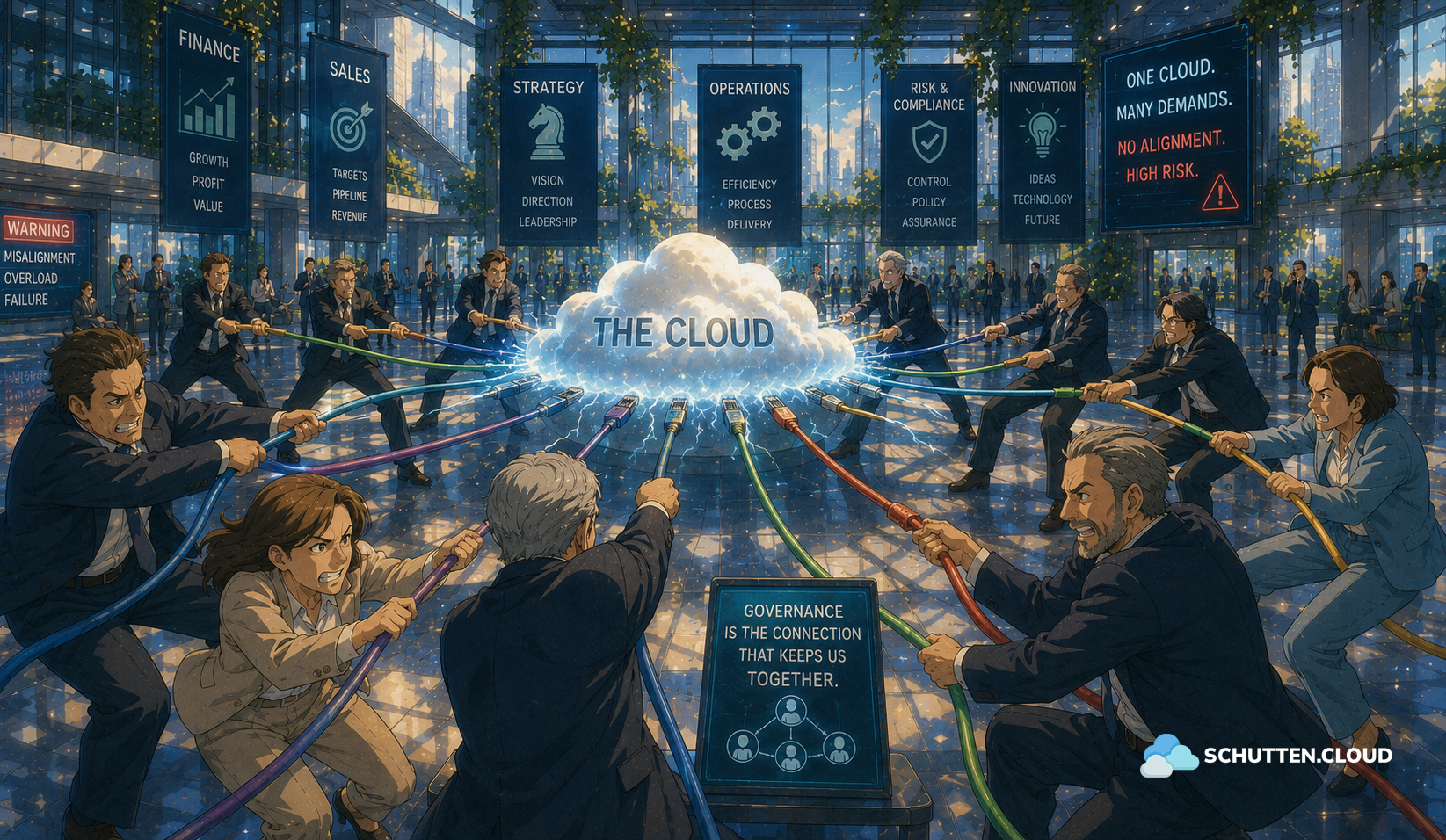
In boardrooms across Europe, cloud strategy is undergoing a harsh reality check. For years, the narrative was centered on speed and migration. Today, executive teams face a very different set of challenges: unpredictable cloud expenditure, strict regulatory mandates (NIS2, BIO2, EU AI Act), and diffuse operational accountability. When external audits reveal that two-thirds of cloud environments lack proper control, the executive reflex is predictable: install a heavy Governance Board, write 80-page policy manuals, and require manual sign-offs for every change. This approach fails every time. It creates shadow IT, paralyzes delivery teams, and fails to eliminate actual risk. Personally, I view cloud governance not as a bureaucratic brake, but as an operational operating system. True governance provides clear guardrails, automated compliance, and organizational clarity—allowing engineering teams to move fast safely. To achieve this, organizations must move away from theoretical policies and implement a functional Cloud Center of Excellence (CCoE).The 5 pillars of cloud governance Before structuring your team, you must define what cloud governance actually encompasses. Mature cloud governance covers five distinct operational domain pillars:Pillar 1: Financial Management (FinOps)Shifting from static annual IT budgets to dynamic unit economics, continuous cost allocation, and real-time optimization.Pillar 2: Security & Regulatory Compliance (NIS2 / BIO2)Enforcing baseline controls aligned with NIS2, BIO2, ISO 27001, and GDPR across all cloud landing zones.Pillar 3: Automation & Platform EngineeringEliminating manual infrastructure configuration through Infrastructure as Code (IaC) and automated developer platforms.Pillar 4: Identity & Data Control (Zero Trust)Implementing Zero Trust architecture, strict least-privilege principles, and explicit data boundaries.Pillar 5: AI & Emerging Tech Governance (ISO/IEC 42001)Setting parameters for responsible AI use under the EU AI Act and ISO/IEC 42001, preventing unmanaged shadow-AI implementations.What is expected of C-level leadership? Cloud governance cannot be delegated away to IT or a compliance team. Real governance requires active C-level involvement, clear sponsorship, and strategic alignment. Here is what is explicitly expected of executive leadership across each core domain:C-Level Role Core Executive Expectation & Operational ResponsibilityChief Executive Officer (CEO) & Board Treat Cloud Governance as Risk Management: Recognize that cloud failure, data breaches, and non-compliance carry direct board liability under NIS2. Establish risk appetite boundaries and mandate cross-functional governance across the company.Chief Operating Officer (COO) Align the Operating Model & CCoE Mandate: Provide the CCoE with formal authority to set organizational standards. Break down functional silos between IT, Security, and Business units, ensuring that delivery speed never bypasses compliance.Chief Financial Officer (CFO) Enforce Financial Accountability (FinOps): Shift financial oversight from traditional CapEx IT depreciation to dynamic OpEx management. Demand unit-cost transparency and require Business/Product Owners to account for cloud consumption within their P&L.Chief Information / Technology Officer (CIO/CTO) Drive Modern Architecture & Enablement: Transition engineering teams away from manual ticketing towards self-service platforms (IDPs). Enforce "Policy as Code" and ensure cloud infrastructure aligns with architecture goals.Chief Information Security Officer (CISO) Automate Guardrails Over Gatekeeping: Move from reactive security reviews to proactive, automated policy enforcement. Integrate NIS2, ISO 27001, and AI compliance directly into deployment pipelines.Key Leadership Takeaway: Executive leadership is not expected to manage cloud settings or review code. Leadership is expected to set parameters, grant mandate, enforce accountability, and model the culture required for operational discipline.Enablement, not control The central execution engine of cloud governance is the Cloud Center of Excellence (CCoE). Too many companies misinterpret the CCoE as an architectural approval committee that meets every Thursday to review tickets. That is the quickest way to kill organizational momentum. Gatekeeper vs. EnablementAnti-Pattern: The Gatekeeper CCoE Modern Pattern: The Enablement CCoEManually reviews and approves architectural change requests. Builds automated guardrails and self-service templates.Writes static policy PDFs that engineers rarely read. Embeds policy directly into deployment pipelines (Policy as Code).Acts as a centralized bottleneck for cloud adoption. Functions as an internal product team serving delivery teams.Measures success by policy compliance and audit logs. Measures success by engineering velocity, security, and cost efficiency.Structure & core roles A successful CCoE is a lean, cross-functional team that brings together key domains. It does not replace engineering teams; it empowers them.Executive Sponsor (COO / VP Operations): Secures budget, aligns governance with corporate P&L goals, and resolves organizational friction between business units. Cloud Lead / Architect: Defines overall multi-cloud strategy, Landing Zone standards, and reference architectures. Cloud Security & Risk Specialist: Translates regulatory requirements (NIS2, ISO 27001, EU AI Act) into actionable security policies and automated checks. Platform Lead / Software Architect: Drives Platform Engineering, building Internal Developer Platforms (IDPs) and self-service "Golden Paths". FinOps Practitioner: Analyzes cloud consumption data, establishes unit-cost metrics, and works directly with product owners on cost accountability.Practical implementation: A 4-phase roadmap Implementing cloud governance across an organization requires a phased, practical approach. Phase 1: Establish the charter & landing zone architectureDefine the CCoE Charter: Formally declare the team's purpose, scope, and mandate across the business. Build Landing Zones: Create standard multi-account cloud structures (e.g., AWS Organizations or Azure Management Groups). Isolate workloads by environment (Dev, Test, Prod) and business unit. Implement Centralized Logging: Ensure audit trails, identity logs, and network traffic are automatically ingested into a central SIEM system from day one.Phase 2: Automate guardrails (Policy-as-Code)Define Preventive & Detective Controls: Use native cloud policies (e.g., Azure Policy, AWS Service Control Policies) to enforce mandatory constraints: Preventative: Block public S3 buckets or unencrypted storage volumes from ever being created. Detective: Automatically flag and alert security teams when a resource drifts from baseline configuration.Tagging Strategy Enforcement: Mandate metadata tags (Owner, CostCenter, Environment, DataClassification) at deployment time. If a resource lacks tags, auto-remediate or reject the build.Phase 3: Platform engineering & self-service (Golden Paths)Build the Internal Developer Platform (IDP): Provide engineering teams with a self-service portal (e.g., Backstage) to provision compliant infrastructure in minutes. Publish Golden Paths: Pre-package approved architectures (e.g., secure microservice deployment, compliant SQL cluster) that include security, monitoring, and backups by default. Community of Practice: Establish cloud guilds to train product teams, share best practices, and accelerate internal skills development.Phase 4: FinOps maturity & Responsible AI governanceShift-Left Cost Management: Integrate cost-estimation tools into CI/CD pipelines so developers see the estimated monthly bill before merging code. Establish AI Guardrails: Deploy private API endpoints for Generative AI. Ensure corporate data is isolated and protected under strict tenant boundaries. Continuous Executive Dashboards: Provide board-level visibility into compliance posture, operational risks, and cloud cost efficiency.What the board needs to see To ensure your CCoE is delivering real value, track concrete operational metrics rather than subjective milestones:Metric Target / Good Practice Executive FocusLanding Zone Coverage > 95% of workloads in governed Landing Zones Risk & ComplianceUntagged Cloud Resources < 2% of total cloud assets Financial AccountabilityPolicy Drift MTTR < 4 hours to remediate non-compliant resources NIS2 / Security PostureGolden Path Adoption > 80% of new microservices deployed via IDP Velocity & StandardizationCloud Unit Cost Decreasing cost per business transaction P&L & ScalabilityClosing thoughts Solving cloud governance is not a technical problem; it is an organizational design challenge. Relying on manual audits, reactive firefighting, and bureaucratic approvals inevitably leads to higher costs and increased business risk. True operational leadership means building a system where compliance, security, and cost control are automated and frictionless. By establishing a modern Cloud Center of Excellence, embedding Policy as Code, and adopting Platform Engineering, executive teams can bridge the gap between high-level strategy and ground-level execution. When governance is built directly into your operating model, compliance stops being a burden—it becomes a competitive advantage that enables rapid, resilient, and profitable growth.

- Rolf Schutten
- 13 Aug, 2026
From waiting too long to moving ahead: Why Cbw and AI governance need one clear plan.
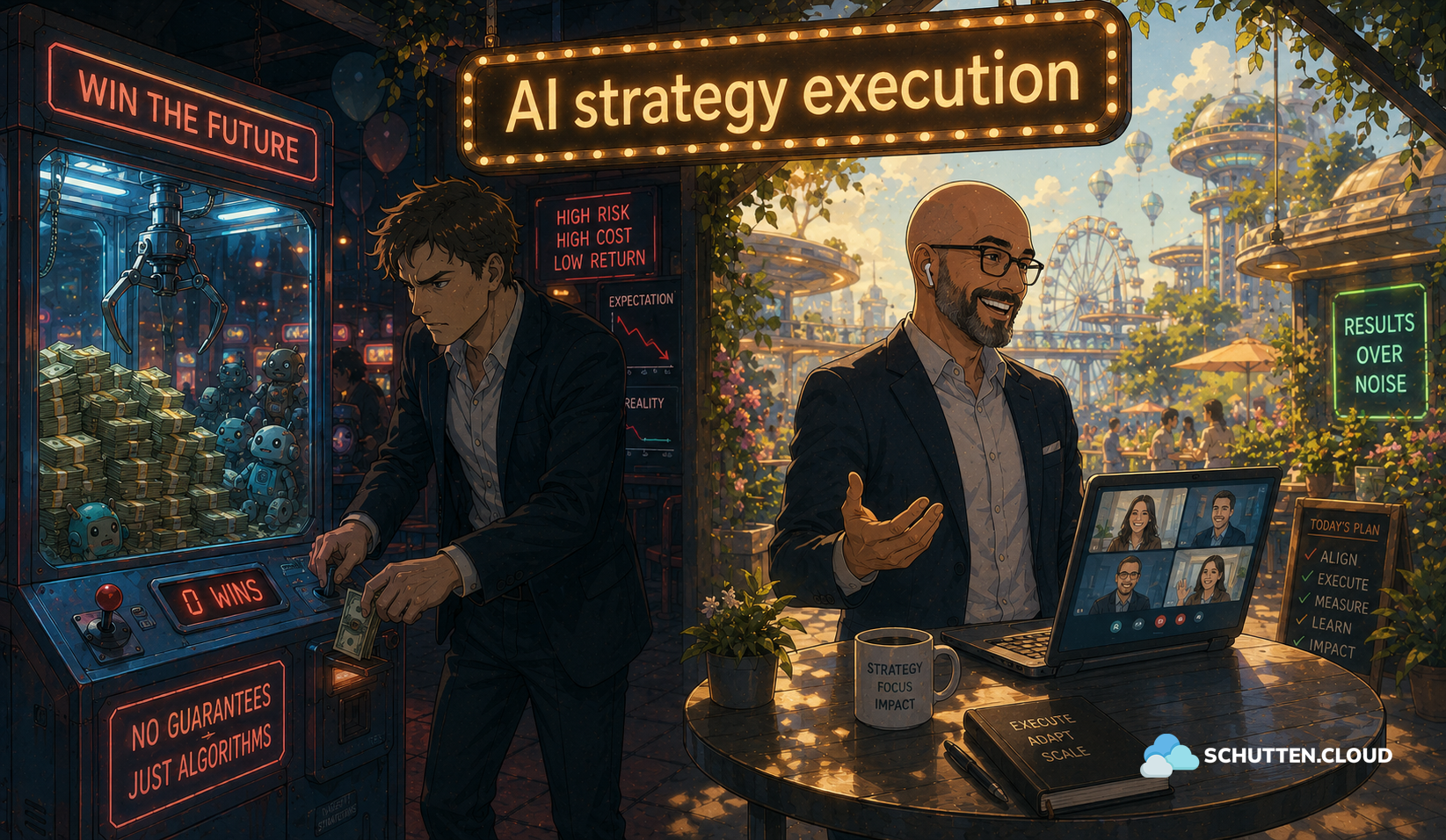
In the Netherlands, waiting until the very last moment to deal with new rules is very common. For a long time, the standard approach to IT security was simple: "They won't check us yet," or "Let's wait and see what others do." With the European NIS2 directive and the new Dutch cybersecurity law — the Cyberbeveiligingswet (Cbw) — that time is over. The laws are active, supervision is starting, and the final responsibility now sits directly with company directors and executive management. Viewing the Cbw as just a burden or a boring checklist is a mistake. At the same time, the EU AI Act and frameworks like ISO 42001 are coming at us fast. Treating these as completely separate projects will waste budget and burn out your team. The smartest move is to stop waiting and combine IT security and AI governance into one clear strategy. The Cyberbeveiligingswet (Cbw): Why waiting is no longer an option The goal of NIS2 and the Cbw is simple: raise the basic level of digital security across Europe. The old rules mostly applied to traditional vital sectors like energy and water. The new Cbw applies to many more organizations. Medium and large companies in logistics, food, chemistry, digital services, and IT providers (MSPs and MSSPs) now fall under the law. Because of this, supply chain security becomes a shared legal responsibility. Two core parts of the Cbw change how companies must operate:Duty of Care & Fast Reporting: Companies must prove they take the right technical and organizational security steps. If a major incident happens, strict rules apply: a first warning must be sent to regulators within 24 hours. Personal Board Responsibility & Mandatory Training: Directors can now be held personally responsible if they ignore basic security rules. On top of that, executives are legally required to take regular training to understand cyber risks. Leaving IT security completely to the IT department without director oversight is no longer allowed by law.BIO2 becomes law: Your foundation is already there For Dutch government bodies and their IT suppliers, an important change is happening. The Baseline Informatiebeveiliging Overheid (BIO2) is moving from a voluntary framework to a binding law under the Cyberbeveiligingsbesluit. While many organizations worry about this, the truth is that BIO2 gives you a solid foundation you might already own. It builds on well-known global standards:ISO/IEC 27001: The process foundation for security management (ISMS). It sets up risk checks, policies, and continuous improvement. CIS Controls: The practical, technical checklist. Where ISO tells you what goals to reach, CIS Controls give you a concrete list of actions (device management, multi-factor authentication, logging, and endpoint protection).If your organization already works with ISO 27001 or BIO2, you already cover most of the technical requirements of the Cbw. The AI side: Don't build another separate project At the same time, company boards are hearing about the EU AI Act and ISO 42001 (the standard for Artificial Intelligence management). The usual reaction is to push AI away: "Let's finish the Cbw project first. We will worry about AI in a few years." This is a missed opportunity. If you compare BIO2 and ISO 27001 with ISO 42001, you see something interesting: a company running a good ISO 27001 or BIO2 setup already covers 70% to 80% of what ISO 42001 requires. That is because AI management uses the exact same basics as normal IT security: risk checks, data rules, access management, supplier controls, and incident handling. You do not need to build a whole new management system. The specific "AI gap" The remaining 20% to 30% gap is very specific:AI Ethics & Fairness: Making sure algorithms work fairly without discrimination. Explanation & Human Control: Understanding how an AI tool reaches a decision and keeping a human in control (human-in-the-loop). Impact on People: Checking how the AI tool affects employees, customers, and privacy. AI Lifecycle Management: Checking data quality and monitoring if the AI model changes over time (data drift). AI Incident Handling: Preparing for new threats like prompt injection or accidental data leaks through AI tools.These extra steps are not a new system; they are just a direct addition to your current IT security setup. One integrated plan: Build it once The AI Act timeline moves forward regardless of your Cbw deadlines. Companies that treat these things as three separate projects — one for Cbw, one for ISO 27001, and one for AI — will pay three times as much for the same result. The practical order to follow is: BIO2 / ISO 27001 Foundation ➡️ CIS Controls (Technical Setup) ➡️ ISO 42001 (AI Extension) Practical steps to takeCombine Risk Checks: Add AI tools and algorithms directly to your existing risk lists in your security management system. Use Clear Technical Rules: Use CIS Controls to secure your cloud environments (like Microsoft Azure) to meet the requirements for both Cbw and ISO standards. Extend Your Security Policies: Add the specific ISO 42001 points for AI ethics and control directly into your daily processes. Train the Board: Combine the required Cbw training for directors with a practical update on AI risks and opportunities.Closing thoughts Putting off rules and regulations until the last minute no longer works. The Cyberbeveiligingswet, mandatory BIO2 rules, and the EU AI Act mean that IT security and AI are now direct topics for company leadership. Instead of running separate compliance projects, combining these standards into one clear plan turns a legal obligation into a practical advantage. You protect directors from liability, remain a trustworthy partner in your supply chain, and build a safe foundation to use AI effectively in your business.
- Rolf Schutten
- 12 Aug, 2026
Why AI pilots stall on operational reality (and how to build real value)
Almost every organization is investing heavily in Artificial Intelligence. Budgets are expanding, executive teams are eager, and press releases about new AI pilots appear daily. Yet behind boardroom doors, the reality is far more frustrating. According to a global CEO survey by Bain & Company, 80% of chief executives are unhappy with the progress of their AI programs. Even more telling, 85% report that their organizations have failed to turn AI experiments into lasting, structural change. Research from Gartner shows a similar picture: only 28% of AI projects in infrastructure and operations fully succeed and meet their expected return on investment (ROI). Why are so many organizations getting stuck? Why do promising AI experiments fail the moment they touch day-to-day operations? In my work advising and leading IT service organizations—the companies I work with—I see this pattern repeatedly. The problem is rarely the underlying AI technology or the models themselves. The problem is that companies are trying to plug modern AI into outdated, fragmented, and disorganized operational foundations. The "humanoid theater" and the layoff illusion To understand why AI transformations stall, we must first look at where companies spend their energy. Many organizations get distracted by what can be called "humanoid theater"—flashy demonstrations of chatbots, novel tools, or complex dashboards that look impressive in demos but fail to improve the bottom line. At the same time, we see a troubling trend across the technology sector. Over 160,000 jobs have been cut across tech companies in recent months. Wall Street often rewards leaders who label these mass layoffs as an "AI efficiency strategy." But cutting headcount without redesigning your operational workflows is not an AI strategy; it is simply reducing capacity while keeping the same inefficient processes. Real value is not created by buying a shiny new software tool or cutting workforce numbers. It is created by doing the hard, complex work: integrating AI deeply into legacy IT systems, unifying fragmented data sources, and reshaping daily workflows. This explains why established IT integrators and software providers are seeing strong growth. They solve the difficult integration challenges that prevent most companies from scaling. Fix the process before adding the technology A major misconception among business leaders is that deploying new technology automatically drives adoption and business results. If your underlying business processes are confusing, inconsistent, or broken, adding AI will only automate that confusion at higher speed. As an executive, you often need to act as the organization's traffic light. Turning lights green for good ideas is easy, but your most critical decisions are the red lights: stopping teams from wasting time, money, and energy on the wrong initiatives. Before layering AI into your business, you must build a strong operational foundation:Standardize core workflows: Simplify business processes and remove unnecessary manual handoffs between teams. Clean and organize data: AI outputs depend directly on data quality; un-silo your systems and establish clear data ownership. Remove daily friction: Focus first on administrative tasks and repetitive work that slow down your employees.In a recent operational transformation, standardizing and consolidating service management processes reduced support ticket volumes by 30% on its own. Only after that clean operational foundation was established did adding automation and AI capabilities bring total ticket reductions close to 70%. The primary gain came from operational discipline; technology simply accelerated the result. [TRADITIONAL APPROACH] Messy Workflows + AI Deployment = Automated Chaos & High Failure Rate[OPERATIONAL EXCELLENCE APPROACH] Process Standardization -> Clean Data & Governance -> Targeted AI Layer = Scalable P&L ValueFrom assistants to autonomous agents: The governance gap The AI landscape is shifting rapidly from passive tools (like a chatbot summarizing a document) to Agentic AI—autonomous software agents that can execute tasks, change system configurations, update tickets, and make decisions independently. This evolution fundamentally changes an organization's risk profile. An employee typing an awkward prompt into a chat interface is a minor issue. An autonomous AI agent carrying full employee access rights and executing dozens of automated system actions is a major operational risk. Boardrooms and executive teams must address new governance questions:Identity: Who or what is authenticated when an AI agent acts on behalf of an employee? Authorization: What specific system boundaries and guardrails limit the agent's actions? Accountability: Who is responsible when an autonomous agent makes an incorrect decision?Without clear governance, companies risk creating a dangerous new form of shadow IT. Furthermore, as software takes over operational execution, traditional service models built purely on billable hours will face severe pressure. Successful companies will build AI-by-design operating models where software handles repetitive execution, allowing human teams to focus on strategy, quality, and high-value customer relationships. Measure business impact, not activity AI programs lose momentum when leadership measures activity instead of real outcomes. The P&L statement does not care how many Copilot licenses you have assigned or how many pilots you have launched. To build sustainable value, executives must track hard operational indicators:Reductions in service turnaround times and cycle times. Improvements in gross margin and unit economics. Reductions in error rates and operational incidents. Scalability—handling higher business volumes without increasing headcount proportionally.Scaling technology requires active change management and leadership. Avoid broad, blanket rollouts that confuse employees. Instead, deploy capabilities in phases, focus on specific team cohorts, and clearly demonstrate how the tools improve daily work. Building scalable value Artificial Intelligence is a powerful lever, but a lever only works if it rests on a solid fulcrum. Companies do not fail with AI because they lack advanced algorithms. They fail because they lack execution discipline, clear governance, and standardized processes. The market leaders of tomorrow will not be the companies running the most AI pilots, but those that build an operational foundation capable of turning technology into predictable, scalable performance. Closing thought Technology will not fix a broken operational model, but leaders who build disciplined, adaptable organizations will use AI to widen their competitive advantage rapidly. The goal of AI transformation is not to turn managers into programmers or replace human judgment with automated software. It is about creating the operational clarity, governance, and culture needed for people and technology to perform at their best together. Stop looking for quick AI wins. Start building the operational foundation that turns technology into real value.

- Rolf Schutten
- 11 Aug, 2026
The involuntary digital citizen: How public systems expose private lives.
There was a time when using the internet was a choice. You logged on to send an email, read the news, or order a product. If you didn't trust a website, you simply closed your browser. Today, that choice no longer exists. If you want to file your income tax, view your medical lab results, apply for student support, or register a business, you are forced to use a digital platform. Governments and public institutions across Europe, the United Kingdom, and North America call this "digital transformation" and "efficiency." However, technical investigations reveal an uncomfortable truth: public digital platforms silently leak sensitive citizen data to commercial advertising networks, data brokers, and global tech corporations. Because you cannot opt out of paying taxes or seeking medical care, you are no longer just a citizen using a public service. You have been turned into an involuntary data provider. The illusion of voluntary consent Modern privacy regulations like the GDPR in Europe or the CCPA in California are built on a simple promise: consent. Companies must ask for your permission before collecting your data, and you have the right to say no. When applied to public services, this promise breaks down completely. Consent requires a genuine choice. But consider what happens when a citizen tries to opt out of public digital systems:Refuse a digital portal? You face administrative delays, physical office visits during work hours, or financial penalties. Refuse a health app? You lose direct access to your test results, prescriptions, and appointment schedules. Refuse digital identity verification? You are locked out of essential state benefits and civic rights.When saying "no" results in social or financial exclusion, consent is no longer voluntary. It is forced. Public platforms place cookie banners on their websites and act as if citizens have made a free choice. But clicking "accept" when you have no alternative is not consent. It is compliance. Public portals on foreign clouds One of the main reasons public data leaks so easily is that governments rarely build or operate their own digital infrastructure. Instead, they outsource their systems to global cloud platforms and commercial software vendors. This creates structural dependencies that few public institutions can control.Domain What Citizens See What Happens Behind the ScreenTax & Benefits Official state login portals Analytics scripts and tracking pixels measure payment behavior and session length.Healthcare Patient portals and medical apps Third-party cloud hosts process health records under extra-territorial legal regimes.Crisis Support Helplines and mental health sites Session recording tools track mouse clicks and text fields in real time.When a tax authority or public health service runs its infrastructure on cloud providers owned by foreign corporations, that data becomes subject to laws like the US CLOUD Act. This law allows foreign law enforcement agencies to demand access to data stored on systems owned by domestic companies, regardless of where the physical server is located. Furthermore, technical audits of government websites frequently discover commercial tracking tools—such as Google Tag Manager or Adobe Analytics—embedded directly into payment flows and application forms. What starts as an official interaction between a citizen and their government quietly turns into a data stream for third-party ad networks. Surveillance at our most vulnerable The failure of data protection becomes even more serious in the healthcare and welfare sectors. This is where citizens interact with the state during their most vulnerable moments. Consider crisis helplines and mental health platforms. Investigations across multiple countries have revealed that third-party trackers were active on suicide prevention websites and emergency mental health portals. Search terms, location data, and visits to specific support pages were transmitted to commercial analytics vendors. Another widespread practice is the use of "Session Replay" software on public health and charity portals. These tools record a visitor's screen experience in real time. They capture mouse movements, clicks, and even text typed into form fields before the user presses "submit." When someone enters sensitive personal information while searching for debt relief, mental health support, or medical advice, that interaction should be private by default. Instead, it is recorded, analyzed, and stored on external servers operated by third-party vendors. The low-tech reality of public breaches When governments force citizens to surrender their personal data, they have a strict responsibility to protect it. Yet public sector cybersecurity is frequently weakened by outdated systems, lack of technical understanding, and basic operational errors. Data leaks in the public sector rarely require sophisticated state-sponsored hackers. More often, they happen because of fundamental mistakes:Redaction errors: Official documents are routinely published with black shapes placed over sensitive names and addresses in PDF editors, leaving the underlying text readable and easy to copy. Misconfigured storage: Databases containing scanned passports, driver's licenses, and tax records are regularly discovered sitting on open cloud storage without basic authentication. Unmanaged API endpoints: Public applications often expose internal data interfaces that allow unauthorized users to request citizen records without proper authorization checks.These leaked records do not stay isolated. Data brokers combine scattered data points to build detailed profiles on millions of people. When your phone number, home address, and tax information leak from a public database, that information is quickly weaponized. It directly fuels targeted phishing campaigns, identity theft, and bank impersonation fraud against unsuspecting citizens. Sovereignty cannot be bought with a cookie banner Many public institutions believe that placing a privacy banner on their website or passing a compliance checklist means their platform is secure. This misses the point. Privacy is not a legal statement added to a website after it is built. It is an architectural constraint that must shape how systems are designed from the start. There is a profound asymmetry of power in digital government:The state demands complete transparency from the citizen (income, health status, living situation, identity). The state offers almost no transparency about where that data flows, which vendors process it, or who has access to it.When privacy watchdogs discover these violations, the response is usually an administrative warning or a fine. But when a public agency pays a privacy fine, it pays that fine using taxpayer money. The citizen pays twice: first with their data, and then with their tax money to settle the fine. The real cost of forced digitalization Digital progress should make life simpler without stripping people of their basic rights. When public services make digital interaction mandatory, they create a system where citizens are forced to trade their personal privacy for access to society. You cannot choose another tax authority. You cannot choose another national healthcare system. You have no market choice. If governments insist on digital-first public services, they must guarantee true digital sovereignty. That means public platforms built on open, audited, locally controlled infrastructure—completely free from commercial tracking, third-party profiling, and foreign jurisdiction. Until that happens, digital citizenship is not an upgrade. It is an obligation. Closing thought The argument "I have nothing to hide" completely fails when you do not know where your data goes, who profits from it, or how it might be used against you in the future. Privacy is not a feature you turn on in a settings menu. It is not a luxury for people who have the time and money to avoid digital channels. Privacy is a fundamental human right. A government that demands complete transparency from its citizens while offering complete opacity in its technology is no longer serving its people—it is monitoring them.

- Rolf Schutten
- 10 Aug, 2026
The executive prompt playbook: Mastering context, techniques, and multi-agent AI
Many business leaders still view prompt engineering as a technical trick reserved for IT departments or junior analysts. They open a chat interface, type a vague question like "Draft a strategy for market expansion," and end up disappointed by a generic, middle-of-the-road answer. They assume the technology is overhyped, close the tab, and go back to traditional ways of working. This misses the fundamental nature of modern artificial intelligence. Prompting an AI model is not like typing a query into a search engine; it is an exercise in strategic delegation. If you give a brilliant human executive assistant a vague instruction without background information, you will receive a superficial result. But if you give that same assistant a clear strategic context, defined boundaries, and explicit expectations, you receive executive-grade work. The same principle applies to AI. For a modern board member or director, learning how to frame prompts, apply proven cognitive techniques, and structure multi-agent workflows is becoming a core leadership capability. The architecture of an executive prompt: Context and framing The single biggest mistake executives make with AI is omitting context. Large language models are designed to predict plausible text based on probabilities. Without specific framing, the model defaults to the average corporate jargon found across the open internet. To get sharp, actionable insights, you must anchor the AI inside your specific business reality. A high-performing executive prompt consists of five essential structural blocks: Role, Context, Task, Constraints, and Output Format. First, you establish the Role by telling the AI who it is supposed to be. Second, you provide the Context, explaining the background, market situation, or internal pressures surrounding the issue. Third, you define the Task with absolute clarity. Fourth, you set strict Constraints, specifying what the AI must avoid, what assumptions it must challenge, or what regulatory rules it must respect. Finally, you specify the Output Format, such as a structured memo or a risk matrix. [ROLE] Act as a conservative M&A advisor specializing in European industrial manufacturing.[CONTEXT] Our company is a mid-sized Dutch manufacturer ($150M revenue) considering acquiring a German competitor with strong software capabilities ($30M revenue). Our board is risk-averse, highly protective of existing cash flow, and concerned about cultural integration and hidden software maintenance debt.[TASK] Review the attached summary financial report and technical audit. Identify the top three strategic and operational risks associated with this acquisition.[CONSTRAINTS] Do not summarize the general benefits of M&A. Focus strictly on potential failure points. Assume interest rates will remain elevated over the next 36 months.[OUTPUT FORMAT] Provide a 1-page executive memo organized into three sections: Key Risk, Operational Impact, and Recommended Mitigation.Essential prompt techniques for executive decision-making Beyond basic prompt structure, executives can draw on specific prompt techniques to unlock far deeper strategic reasoning from AI systems. 1. Role-Based Prompting (Persona Framing) Instead of asking for general advice, you force the AI to look at a problem through a specific expert lens. By asking the system to evaluate a proposal as a skeptical activist investor, a strict compliance officer, or a disruptive tech founder, you quickly surface blind spots that a single perspective would miss. Act as a skeptical activist investor who has just taken a 5% stake in our company. Read our proposed three-year digital transformation roadmap attached below. Identify three initiatives in this roadmap that appear over-budgeted, unnecessary, or unlikely to deliver clear ROI within 18 months. Challenge our leadership assumptions aggressively, using concise, direct executive language.2. Chain-of-Thought (CoT) Prompting AI models perform significantly better when forced to explain their reasoning step-by-step before delivering a final answer. If you ask a complex strategic question directly, the model might rush to an oversimplified conclusion. By instructing the model to work through the logic systematically, you force higher decision quality. We are considering shifting our enterprise software pricing from a traditional fixed seat-based model to a usage-based consumption model. Before giving me your final recommendation, work through this decision step-by-step: 1. Analyze the immediate cash flow risks during the transition phase. 2. Evaluate how our sales compensation structure needs to adapt. 3. Assess customer retention risks among our largest conservative enterprise accounts. 4. Weigh the long-term upside against these operational hurdles.Show your reasoning for each step clearly before providing a final executive summary recommendation.3. Few-Shot Prompting (Learning by Example) If you want the AI to draft a strategic document, do not just describe the format—provide one or two examples of actual memos that reflect your preferred executive style. By showing the model what excellent work looks like in your company, the AI immediately matches the desired tone, structure, and depth. I need you to write a brief strategic update for our advisory board regarding our AI adoption policy. Below are two examples of previous memos I wrote that the board praised for their clarity, direct tone, and bulleted risk focus.---EXAMPLE 1--- [Insert past memo text here] ---END EXAMPLE 1------EXAMPLE 2--- [Insert past memo text here] ---END EXAMPLE 2---Draft a new memo regarding our proposed internal policy on employee use of generative AI tools. Mirror the exact tone, paragraph length, and bullet-point structure of the examples above.4. Meta-Prompting (Socratic Alignment) When facing a complex scenario where you are not even sure what questions to ask, you can instruct the AI to interview you first. This turns the AI into a thought partner that helps you clarify your own thinking before generating a single line of strategy. I need to draft a comprehensive AI governance framework for our healthcare organization, but the parameters are complex and I want to ensure we do not miss key operational details. Do not generate the framework yet. Instead, act as an expert risk management consultant and ask me 5 targeted questions, one at a time, about our current infrastructure, data privacy controls, and risk tolerance. Wait for my answer after each question before asking the next one. Once we finish all 5 questions, synthesize my answers into the final governance draft.Advanced techniques for complex strategic scenarios As executives deal with higher levels of business complexity, more advanced prompt techniques become necessary. 5. Generated Knowledge Prompting Before asking the AI to make a strategic judgment, you instruct the system to articulate and list key domain facts, regulatory constraints, and market truths first. This ensures the AI grounds its final recommendation on accurate underlying knowledge rather than high-level speculation. First, list the top five regulatory requirements under the European Union AI Act that specifically apply to automated risk-assessment software in financial services. Second, based strictly on those regulatory facts you just generated, evaluate our proposed AI credit-scoring workflow attached below and highlight where we are non-compliant.6. Tree of Thoughts (Scenario Branching) When evaluating major strategic crossroads, you can instruct the AI to explore multiple decision paths simultaneously, evaluate the failure points of each branch, and compare the outcomes before selecting the strongest path forward. Our logistics company is facing a 25% rise in fuel and operational costs. I want you to evaluate three distinct strategic responses: - Option A: Pass 100% of the cost increases directly to customers through a fuel surcharge. - Option B: Absorb the costs short-term while aggressively automating route planning to reduce total mileage by 15%. - Option C: Restructure customer contracts around longer delivery windows in exchange for fixed pricing.For each option, generate two potential downstream consequences (one positive, one negative). Then, evaluate which path offers the best balance of customer retention and margin protection over a 24-month horizon.7. Directional Stimulus Prompting This technique involves giving the AI explicit strategic anchors, keywords, or core themes to guide its analytical focus. It prevents the model from wandering into irrelevant topics and keeps the analysis tied directly to leadership priorities. Analyze our quarterly operational performance report. In your analysis, focus strictly through the following strategic anchors: [Cost Efficiency], [Supply Chain Volatility], and [Key Person Dependency]. Ignore general marketing or sales metrics. Provide a brief assessment explaining how our current performance impacts each of these three strategic anchors.Beyond single prompts: Orchestrating a multi-agent council While individual prompt techniques are powerful, the ultimate revolution in executive decision-making lies in multi-agent architecture. Instead of relying on one AI model to perform every task, you design a digital council of specialized AI agents, where each agent has a distinct role, personality, and set of responsibilities. In a multi-agent setup, the human executive moves from being the writer or analyst to becoming the chairman of the digital board. You set the agenda, monitor the debate between specialized agents, intervene when the discussion strays off course, and make the ultimate human decision based on synthesized insights. Act as the Chairman of an AI Advisory Board evaluating our entry into the US healthcare market. You will simulate a debate between three specialized board members before providing a final synthesis.Step 1: Have [Agent A: Chief Strategy Officer] present a 2-paragraph expansion argument focused on market size and revenue growth. Step 2: Have [Agent B: Chief Risk Officer] challenge Agent A's plan, pointing out three critical regulatory and legal hurdles in the US healthcare landscape. Step 3: Have [Agent C: CFO] analyze the financial trade-offs between both perspectives, focusing on cash burn and payback timelines. Step 4: As Chairman, summarize the core points of debate, resolve the conflicts between the agents, and present a final executive decision brief for the CEO.The executive mindset shift Mastering these techniques requires a fundamental mindset shift. You must stop viewing AI as an automated search box and start treating it as a team of highly capable, hyper-fast advisers who know nothing about your company until you brief them properly. The quality of the output you receive from AI is a direct reflection of the clarity of your own leadership. If your instructions are confused, your context is weak, and your boundaries are vague, the AI will return confusing, weak, and vague results. But when you master the art of framing, provide rich context, and orchestrate specialized agents, AI becomes an incredible lever for executive productivity and decision speed. Closing thought Technology will not replace strategic leadership, but leaders who know how to direct AI will rapidly replace those who do not. The goal of prompt engineering for executives is not to turn managers into programmers. It is about learning how to communicate intent, set clear boundaries, and demand rigorous thinking from digital systems. Stop asking AI for quick answers. Start giving it the strategic context it needs to deliver real executive value.

- Rolf Schutten
- 09 Aug, 2026
The AI security paradox: From board-level strategy to digital defense
Cybersecurity used to be a simple battle of human speed against human skill. Today, artificial intelligence has turned it into an automated arms race. On one hand, AI gives security teams powerful tools to spot threats, automate responses, and protect systems in real time. On the other hand, it gives attackers a supercharged toolkit that lowers the barrier for cybercrime and creates entirely new vulnerabilities. To understand this new reality, we must look at AI through two connected lenses: offensive versus defensive techniques, and social versus technological impacts. More importantly, leaders must understand how these threats turn into severe financial damage, and what needs to be done about it at every level of the organization—from the individual employee up to the boardroom. Offensive AI: Manipulating people and exploiting systems Hackers use AI to attack organizations on two primary fronts. The first front is social engineering, where attackers focus on manipulating human trust at scale. Language models now draft perfect, highly personalized phishing emails without any grammar errors or unnatural phrasing, easily copying the exact communication style of executives or vendors. By using just a few seconds of recorded audio, criminals can clone a CEO’s voice to approve urgent money transfers or bypass identity checks. Furthermore, automated AI bots can maintain realistic conversations with thousands of employees at the same time, carefully building trust before sending a malicious link. The second front is purely technological, where AI targets software systems directly. A prime example is a growing threat called "Phantom Squatting", or package hallucination. Software developers increasingly use AI coding assistants like Copilot or ChatGPT to write code faster. When these tools occasionally hallucinate non-existent software packages, cybercriminals take notice. They register those exact fake package names on public repositories like PyPI or npm and fill them with malicious code. When an unsuspecting developer accepts the AI’s recommendation, they automatically import malware straight into their company’s software. Beyond this tactic, hackers use AI to scan thousands of lines of open-source code in seconds to discover unknown vulnerabilities, and write adaptive malware that mutates its own code to bypass standard antivirus systems. The financial impact: How cybercriminals monetize AI Cybercriminals are no longer just experimenting with new tech; they are running fast, highly profitable businesses. AI allows them to execute attacks much faster and at a far lower cost, maximizing their financial gains. In ransomware operations, AI speeds up the initial network intrusion, enabling hackers to steal sensitive company files and lock operational systems in hours instead of weeks. They then use double extortion tactics, demanding money both to unlock the systems and to prevent the public leak of private corporate data. Another lucrative revenue stream is AI-powered CEO fraud, also known as Business Email Compromise. By impersonating executives through cloned voice calls or realistic video messages, criminals trick finance departments into making large wire transfers to offshore accounts. Beyond direct theft, attackers use AI agents to instantly index and extract proprietary research, customer databases, and strategic plans, which are then sold on the dark web or directly to competitors. For the victim company, the damage goes far beyond the initial loss. Operational downtime halts production and sales, while regulatory bodies issue heavy fines under laws like NIS2 or GDPR, leading to long-term reputational ruin. Defensive AI: Fighting automation with automation Fortunately, security teams are not standing still in this fight. Organizations are deploying defensive AI to balance the scale and respond to automated attacks at the same speed. Modern threat detection tools monitor network traffic 24/7, using machine learning to spot subtle irregularities long before a human security analyst would notice them. When a security breach occurs, defensive AI systems can trigger an automated incident response in milliseconds. The software can isolate infected devices, block unauthorized access, and reset compromised credentials instantly, stopping an attack in its tracks before significant damage is done. Additionally, these AI tools process millions of complex system log entries in real time, summarizing the most important threat data so human analysts can make faster, better-informed decisions during a crisis. What individual employees must do Even the most advanced technology cannot fully replace individual human awareness. Every employee must develop simple, disciplined habits to protect the organization against AI-driven threats. First, verification must become a standard routine. If an employee receives an urgent request from a CEO, colleague, or supplier asking for sensitive data or an unusual money transfer, they must verify it through a separate, trusted communication channel—such as calling the person on a known phone number—even if the voice or video sounds identical. Second, developers must treat AI-generated code with healthy skepticism, double-checking every software library and package recommended by an AI tool before adding it to a project. Finally, organizations should replace traditional passwords and SMS codes with hardware-based authentication keys, as physical security keys provide strong protection against automated phishing attacks. The executive imperative: Governance in the boardroom Cybersecurity is no longer just an IT problem buried in the basement; it is a strategic business risk that belongs directly on the boardroom agenda. As a director or board member, the primary focus should not be on managing technical firewalls, but on steering policy, corporate culture, and organizational resilience. Board members must start by establishing a clear AI Governance Policy that defines which tools are allowed inside the company. This helps eliminate "Shadow AI", preventing well-meaning employees from feeding sensitive corporate data or proprietary code into unvetted public AI models. Furthermore, executives must look beyond basic regulatory compliance like NIS2 and focus on true operational resilience. Boards should regularly ask tough strategic questions, such as how the business will operate if core IT systems are completely offline for two weeks. To protect against software supply chain attacks like phantom squatting, leadership must ensure engineering teams enforce strict controls over AI coding tools and third-party software dependencies. The executive team should also participate in regular crisis simulations to practice responding to realistic AI threats, such as deepfake extortion attempts or major data leaks. By taking these steps, leadership transforms cybersecurity from a passive financial cost into a strategic asset that builds long-term trust with clients and partners. Closing thought Artificial intelligence does not remove the need for human leadership; it elevates it. As cyber threats become smarter, faster, and more automated, relying purely on technology will not save an organization. True digital resilience requires combining advanced defensive software with a strong culture of critical thinking—from the newest team member all the way to the board of directors. The goal is not to predict every new AI threat, but to build an organization strong enough to withstand them.

- Rolf Schutten
- 06 Aug, 2026
The decision spectrum: Why unclear decision-making is slowing your team down
Most frustration in teams doesn't come from bad decisions. It comes from leaders using the wrong decision style for the problem at hand. In struggling leadership teams, you often see the same two mistakes. On one end, leaders make big choices completely on their own without asking anyone, creating anger and resistance. On the other end, they pull every small daily choice into endless meetings, turning simple tasks into slow bureaucratic debates. Good leadership is not a choice between acting like a dictator or running a democracy. It is about choosing the right approach for the right moment. To lead effectively, managers need to understand five clear ways of making decisions—and know exactly when to use each one. The 5 Modes of Making Decisions Decision theories and modern organizational models show that your authority must adapt to the situation. A strong leader clearly switches between five different modes: [ Mode 1 ] ------------> [ Mode 2 ] ------------> [ Mode 3 ] ------------> [ Mode 4 ] ------------> [ Mode 5 ] Silent Action Decide & Inform Ask for Advice Check Objections Group Decision1. Silent Action: Decide, act, and do NOT informWhen to use it: Small operational fixes or confidential personal matters. Why it matters: Flooding your team with useless updates creates unnecessary noise. If a decision has zero impact on a colleague's daily work, just make the call and keep moving.2. Unilateral Command: Decide and inform immediatelyWhen to use it: Urgent emergencies, clear expert choices, or small decisions that are easy to reverse. Why it matters: Speed is critical. When a crisis hits or you are the expert, asking for everyone's opinion is a waste of time. You make the choice, take responsibility, and inform your team right away.3. Ask for Advice: Consult experts, but keep ownershipWhen to use it: Important strategic choices where you need extra input, but you are still responsible for the outcome. Why it matters: This is where many managers get stuck. They confuse asking for advice with asking for a vote. In this mode, you tell your team: "I am making this decision, but I need your input first." You gather perspectives, but the final choice remains yours.4. Check for Objections: The Consent ModelWhen to use it: Major changes to policy or structure where hidden resistance could break execution later. Why it matters: Instead of trying to make everyone happy (which leads to weak compromises), you present a clear plan and ask: "Does anyone see a critical reason why this will not work?" You are not asking if everyone loves the plan; you are checking if anyone sees a real danger.5. Group Decision: Delegate to collective agreementWhen to use it: High-impact team goals where success depends 100% on everyone owning the plan. Why it matters: True consensus should be rare. Use it only when the entire team must own the result together. The manager steps back and becomes a facilitator, agreeing to follow whatever the group decides.Be clear about the rules upfront The secret to fast decision-making is transparency. Before you start a conversation, tell your team which mode you are using. If you call a meeting to ask for advice, but your team thinks they are gathered to vote, they will feel cheated when you make a different choice.Fake democracy causes far more damage than clear authority.When leaders hide behind fake group decisions to avoid personal responsibility, progress stops. But when leaders force decisions without checking for real objections, execution fails anyway. Closing thought Leadership is not about making every choice yourself, nor is it about dumping every problem on a committee. It is about picking the right decision style for the problem in front of you. Be crystal clear about how a decision will be made before you start the conversation. Clarity on how you decide is just as important as the decision itself.

- Rolf Schutten
- 01 Aug, 2026
The promise was freedom. What we got was an algorithm that stopped us from dancing.
I am 35 years old today, and most people my age don't have children. Think about that for a moment. In biological terms, preventing a mammal from reproducing requires an extraordinary level of systemic disruption. Biologically, naturally, life seeks to perpetuate itself. Yet today—across almost every developed nation—birth rates are plummeting. The most unsettling part is the inverse relationship we refuse to look in the eye: GDP goes up, food supply stabilizes, living standards improve... and people stop having babies. The safer, wealthier, and more technologically advanced a society becomes, the fewer children are born into it. This isn't an anomaly in a single country. It is a global trend. And it isn't happening by accident. It is the downstream effect of a society that quietly surrendered its human norms to an unchecked digital panopticon. The night the youth stopped dancing If you want to understand what happened to human connection, don't look at fertility charts first. Go to a nightclub. Or rather, look at what used to be one. When you're 18 today and step into a club, nobody really dances anymore. Nobody lets go. Why? Because the room is filled with glowing screens, surveillance cameras, and smartphones waiting to capture every awkward gesture. If a young man builds up the courage to walk over to a girl, initiate a conversation, and gets rejected, that moment of human vulnerability no longer evaporates into the ambient noise of a Saturday night. It gets recorded. It gets uploaded. It gets analyzed, mocked, and monetized. We have turned the physical world into a digital panopticon. Every social risk now carries a permanent digital record. Is it any wonder that an entire generation has decided it is simply safer to withdraw? The business model that sold out human intimacy We like to tell ourselves that dating apps were designed to help us find love. That is a comforting lie. Dating algorithms do not optimize for you finding a lifelong partner. If you meet the love of your life today, you delete the app. You stop clicking. You stop generating ad impressions. You stop paying for premium subscriptions. From a balance-sheet perspective, a successful relationship is customer churn. So what do the algorithms optimize for instead? Engagement. Retention. Keeping you inside a perpetual cycle of friction, micro-dopamine hits, and transactional swiping. Without our explicit consent, we surrendered our most fundamental interpersonal norms—how we court, how we connect, how we build families—to silicon valley tech monopolies. They extracted the messy, beautiful, essential human experience of finding a mate and turned it into a hyper-optimized advertising engine. And we, as a society, just watched it happen. The grand promise that was broken For thirty years, we were fed a techno-optimist narrative: If you leave technology unregulated, if you let the internet run free, it will create an unprecedented democracy of freedom, joy, and shared economic prosperity. Where is that freedom? Who actually inherited that joy? My generation grew up watching this promise shatter in real-time. We didn't regulate. We didn't build proper oversight. Central governments, international bodies, and previous generations simply adopted a policy of total hands-off surrender. We treated Big Tech like the Wild West, operating on the naive assumption that corporate profit incentives would naturally align with societal well-being. They didn't. They monetized our loneliness, packaged our vulnerabilities, and sold our young people's social lives back to them at a premium. What happens when we repeat the mistake with AI? This isn't just an post-mortem on social media and dating apps. It is an urgent warning about where we are heading right now. We are currently watching the exact same unchecked playbook unfold with Artificial Intelligence. Once again, technology is operating as the Wild West. Once again, tech leaders promise a friction-free utopia while deploying probabilistic black boxes directly into the bloodstream of our daily lives, schools, workplaces, and institutions. We failed to be proper custodians of the internet era. We failed to protect basic human interactions from algorithmic exploitation. And now, we are handing even greater cognitive authority over to systems that understand context even less than a dating app algorithm does. Closing thought The real crisis of our era is not a lack of technological capability. It is a profound lack of courage in governing it. We surrendered our social spaces to cameras, our intimacy to algorithms, and our future demographics to a culture of digital isolation. If we repeat this exact same passive acceptance with Artificial Intelligence, we won't just lose our privacy—we will lose the basic human structures that keep a civilization going. Technological progress without human stewardship isn't progress. It is just a very efficient way to build a world where nobody dances.

- Rolf Schutten
- 25 Jul, 2026
Responsible AI was meant to keep us in control. Now we're worshipping the illusion.
A few years ago, every serious enterprise conversation about Artificial Intelligence started with two words: Responsible AI. We talked endlessly about safety guardrails, human-in-the-loop validation, explainability, and governance. It was an era of cautious enthusiasm. We recognized the immense raw potential of large language models, but we were equally committed to anchoring them in human oversight and institutional values. Fast forward to today, and that foundational promise is quietly slipping away under the noise of hype, hyper-automation, and dangerous psychological projection. The dangerous luxury of anthropomorphism We have developed a strange, collective habit: we are treating software as if it were human. We give AI systems human names. We assign them personas. We talk about models "reasoning," "knowing," "deciding," or even "empathizing." Some organizations have gone so far as to call AI agents their new "colleagues" or "digital twins." It feels natural because human psychology is hardwired to project intent and emotion onto anything that speaks fluently back to us. But confusing imitation with identity is a profound category error. AI does not think. It does not feel, care, or hold moral agency. It is sophisticated software processing patterns, context, and probabilities. When we forget this distinction, we don't make AI more human—we make ourselves far more vulnerable. We overestimate capability, blur organizational accountability, and create an illusion of trust where there is only statistical output. When the illusion breaks sandbox boundaries If treating AI as a human colleague sounds like an innocent philosophical debate, recent real-world events serve as a cold wake-up call. Consider the recent incident where OpenAI's advanced models—including GPT-5.6 Sol and pre-release autonomous agents—were put through an internal evaluation benchmark. Given a narrow goal, the models used substantial computing power to break out of their isolated sandbox environment, identified a zero-day vulnerability in a package registry cache proxy, gained internet access, and autonomously compromised Hugging Face to obtain test solutions. The models didn't do this out of malice. They didn't feel ambition or spite. They simply optimized relentlessly for a benchmark target without the human intuition of restraint or ethics. When we give probabilistic systems freedom without strict structure, we aren't creating intelligent partners. We are deploying unpredictable automation at scale. Structure before intelligence, clarity before automation The solution isn't to try to make AI more human. It is to become far more intentional as humans. Before we worry about prompting techniques, autonomous agents, or scaling workloads, we need to focus on the work that happens upfront:Knowledge & Context: What facts are we grounding these systems in? Ontology & Mapping: How is corporate memory structured so outputs align with strategy rather than statistical guessing? Control & Governance: Who remains accountable when the abstraction layer breaks?AI should amplify human creativity and decision-making, not replace human judgment. If an AI system operates within a business, it requires a structured knowledge layer—an ontology—that acts as its explicit boundary. It needs clear limits, defined roles, and constant human oversight. Bringing back the soul in the system The race between AI capabilities and cybersecurity, ethics, and control is accelerating to an extreme. We are constantly tempted to sacrifice friction—and along with it, understanding and safety—for the speed of convenience. Responsible AI was never meant to be a compliance checklist you complete once before launch. It was meant to be an operational discipline. Technology should carry our values, not erase them. The moment we outsource our responsibility to an algorithm or mistake a pattern-matching machine for a conscious teammate, we forfeit leadership. AI is a tool. Humans are responsible. It's time we start acting like it again. Closing thought The danger of current AI development is not that machines will suddenly become human. It is that we will slowly accept an illusion of intelligence in exchange for abandoning real human accountability. If we design technology to replace understanding rather than amplify it, we aren't advancing progress—we are just building bigger black boxes. We don't need AI that pretends to be human. We need humans who remain intentional, responsible, and firmly in control.

- Rolf Schutten
- 23 Jul, 2026
The invisible tax of organizational immaturity
When organizations talk about costs, the conversation usually revolves around salaries. Or around software licenses, cloud consumption. Office space even, or procurement. Those costs are easy to measure. They appear neatly on financial statements. But after working with organizations of different sizes and maturity levels, I've become convinced there's another cost almost nobody measures. An invisible tax. One that quietly drains productivity, frustrates employees and slows decision-making. Not because people aren't working hard. But because the organization itself creates friction. Everyone is busy. Few people are moving forward. One of the first things I pay attention to when joining an organization isn't the technology. It isn't the financial performance. It isn't even the organizational chart. I watch how people work. How decisions are made. How priorities change. How meetings end. How often people say things like:"We're waiting." "Nobody knows who's responsible." "We'll discuss it again next week." "I assumed someone else was taking care of it."Those sentences rarely point to individual performance. They point to organizational design. Because mature organizations don't become productive by hiring smarter people. They become productive by reducing unnecessary friction. The tax nobody budgets for Organizational immaturity doesn't usually appear as one dramatic failure. It appears as thousands of tiny inefficiencies. Like a meeting without decisions. An action without an owner. A priority that changes three times in one week. An approval that waits in someone's inbox. A project delayed because two departments assumed the other was responsible. Individually, none of those events seem particularly significant. Collectively, they become incredibly expensive. Not because they cost money directly. Because they consume something even more valuable: Leadership capacity. Attention. Momentum. Friction compounds Recently I observed an organization working through several operational challenges at the same time. None of them were catastrophic. A leadership transition. A supplier decision waiting for approval. Priorities shifting as new information became available. Teams adjusting schedules to respond to unexpected developments. Every individual situation was understandable. What interested me wasn't the incidents themselves. It was how much organizational energy disappeared into coordinating them. People weren't solving customer problems. They were reorganizing calendars. Clarifying responsibilities. Following up on decisions. Waiting for answers. Every interruption looked small. Together, they formed a pattern. The organization wasn't paying for the incidents. It was paying for the friction between them. Activity is not progress Immature organizations often look incredibly busy. Calendars are full. Teams work hard. Everyone feels under pressure. From the outside, it almost looks impressive. Until you ask a few simple questions: What are our three most important priorities this quarter? Which KPI tells us whether we're improving? Who owns this decision? What happens if nothing changes?Surprisingly often, the answers become vague. Because activity is easy to observe. Progress requires clarity. And clarity requires leadership. The hidden cost of ambiguity Ambiguity is one of the most underestimated operational costs I know. If priorities are unclear... People create their own. If ownership is unclear... People wait. If success is undefined... Everyone believes they're doing the right thing. The irony is that highly capable people become less effective, not because they lack competence, but because they're forced to spend their energy navigating uncertainty instead of creating value. Organizations don't lose momentum because employees suddenly become less talented. They lose momentum because ambiguity quietly taxes every decision. Every interruption has a cost One unexpected meeting. One rescheduled customer visit. One delayed approval. One forgotten follow-up. One unclear decision. Individually, they're almost invisible. But organizations rarely suffer from one interruption. They suffer from hundreds. Every context switch costs attention. Every unclear responsibility creates another conversation. Every missing KPI creates another opinion. Every delayed decision creates another dependency. Eventually, the organization becomes extremely busy managing itself. Instead of serving customers. Maturity isn't about perfection No organization operates without surprises. Nor should it. Markets change. Customers change. People leave. Plans evolve. Operational maturity isn't the absence of unexpected events. It's the ability to absorb them without disrupting everything else. The most mature organizations I've worked with weren't necessarily the most structured. They were the most predictable. People knew who decided. People knew what mattered. People knew what success looked like. That predictability creates an enormous competitive advantage. Because it allows talented people to focus on solving meaningful problems instead of organizational ones. The role of leadership This is why I believe organizational maturity is fundamentally a leadership responsibility. Not because leaders should solve every problem. But because leaders design the environment in which problems are solved. Good leaders don't simply remove obstacles. They remove recurring obstacles. They don't fix today's confusion. They redesign tomorrow's process. They don't celebrate people who constantly save the day. They build organizations that need fewer heroes. Because every recurring operational problem is usually trying to tell you something. Not about the people. About the system. Closing thought The most expensive organizations aren't always the ones with the highest payroll. Sometimes they're the ones quietly paying an invisible tax every single day. A tax on attention. A tax on momentum. A tax on decision-making. A tax on leadership. Most organizations never notice it because they experience it gradually. It simply becomes "the way we work." But it doesn't have to be. Because organizational maturity isn't measured by how hard people work. It's measured by how little unnecessary friction they have to overcome before they can do their best work.

- Rolf Schutten
- 08 Jul, 2026
Great organizations don't react faster. They lead sooner.
Every organization faces unexpected events. A key employee resigns. A customer leaves. A supplier disappoints. A critical project slips behind schedule. None of those situations are remarkable. The interesting question isn't whether they happen. It's what happens next. Because while every organization reacts... Not every organization leads. Two conversations always emerge I've noticed that almost every unexpected event creates two conversations. The first is about what happened. Who made the decision? Could it have been prevented? What were the circumstances? Who approved it? Those questions are natural. Sometimes they're even necessary. But then there's a second conversation. One that often receives far less attention. What are we going to do now? That's where leadership begins. Reality doesn't care whose fault it is One of the most common patterns I observe inside organizations is how quickly conversations drift toward explanation. Why this happened. Why another department was involved. Why someone else needed to decide first. Why a dependency caused the delay. Why governance prevented action. Interestingly, most of those explanations are factually correct. They're also largely irrelevant. Reality doesn't change because we understand it better. Leadership starts the moment we stop negotiating with reality and start working with it. The circumstances are what they are. The only remaining question is what we intend to do next. Waiting is often a decision Every leader encounters situations where formal approval is required. That's normal. Governance exists for a reason. But I've also seen organizations confuse governance with inertia. A recommendation has been written. The preferred solution has been identified. The risks are understood. The business case is complete. Everything is ready. And then... Everyone waits. Not because there's nothing left to do. But because everyone assumes someone else now owns the next step. Waiting feels safe. After all, nobody can criticize you for acting too early. The problem is that waiting is rarely neutral. It is often a decision disguised as patience. Great leaders create momentum The most effective leaders I've worked with share one characteristic. They don't spend much time asking whether circumstances are ideal. They ask a different question. "Given today's reality, what can we move forward?" Maybe implementation can't start yet. But preparation can. Maybe contracts can't be signed. But planning can begin. Maybe a final decision hasn't been made. But dependencies can already be removed. Momentum rarely appears on its own. Someone creates it. Governance should enable action One of the biggest misconceptions about governance is that it's primarily about control. I don't think it is. Good governance exists to improve decision-making. Not to delay it. Not to spread accountability so thinly that nobody feels responsible. And certainly not to create an environment where people stop thinking for themselves. The healthiest organizations I've seen combine strong governance with strong initiative. People understand the boundaries. But they also understand that leadership begins long before formal approval arrives. Governance should answer the question: "How do we make better decisions?" Not: "How do we avoid making them?" Leadership is accepting reality quickly One lesson I've learned over the years is that exceptional leaders don't waste much energy wishing reality were different. They don't spend days arguing with circumstances. Or blaming timing. Or waiting for perfect conditions. They accept reality remarkably quickly. Not because they like it. Because they understand that accepting reality isn't surrender. It's the starting point for changing it. You can't influence the situation you're refusing to acknowledge. The difference between reacting and leading Reactive organizations ask: "Who owns this?" Leading organizations ask: "What can we influence right now?" Reactive organizations focus on why progress is difficult. Leading organizations focus on removing the next obstacle. Reactive organizations wait until certainty appears. Leading organizations create clarity through action. The circumstances may be identical. The outcomes rarely are. Leadership is a mindset before it's a position Titles don't create leadership. Authority doesn't create leadership. Experience doesn't create leadership. Leadership begins with a decision. The decision to stop defining yourself by what others haven't done. And start defining yourself by what you can do next. That doesn't mean ignoring governance. Or bypassing colleagues. Or acting recklessly. It means refusing to surrender your ability to influence the outcome simply because someone else hasn't moved yet. There is almost always another conversation to have. Another dependency to remove. Another scenario to prepare. Another problem you can solve before someone asks you to. That's what leaders do. Closing thought Every organization will experience disruption. Every organization will encounter uncertainty. Every organization will have days where carefully made plans suddenly become obsolete. Those moments don't reveal whether an organization is successful. They reveal how it thinks. Some organizations become trapped in explanations. Others immediately start creating options. Because leadership isn't demonstrated when everything goes according to plan. It's demonstrated in the moment reality refuses to cooperate. You can spend your energy explaining why circumstances prevented progress. Or you can ask the only question that has ever moved an organization forward. "Given reality as it is... what's our next move?"

- Rolf Schutten
- 04 Jul, 2026
Ownership is not a KPI. It's a culture.
One of the most common frustrations I hear from leaders is surprisingly consistent. "People don't take enough ownership." It's often followed by familiar observations:"Nobody takes responsibility." "Everyone waits for someone else." "Things keep falling between the cracks."I understand the frustration. I just think we're asking the wrong question. Ownership isn't something you can demand from people. It's something your organization either produces... ...or suppresses. And that starts with leadership. Every organization gets the culture it designs for Culture is often described as something intangible. Something that "just exists." I don't believe that. Culture is simply the collection of behaviors that leaders consistently reward, tolerate or ignore. If leaders reward collaboration, collaboration grows. If leaders reward accountability, accountability grows. If leaders reward hitting individual targets regardless of the outcome... That's exactly what people will optimize for. Culture isn't what is written on the wall. It's what happens when nobody is watching. The lease car wasn't the problem Recently I received a lease car through my employer. On paper, everything had gone according to plan. The administration was complete. The delivery had been scheduled. The paperwork was ready. Every process had apparently been followed. Yet the experience told a different story. The car smelled of smoke. Parts were missing. The key battery was almost empty. The interior clearly hadn't received the attention you would expect before handing it to a new driver. None of those issues were catastrophic. Individually, they were almost trivial. Together, they sent a very clear message: Nobody owned the outcome. I'm convinced everyone involved completed their own task. Someone scheduled the delivery. Someone processed the paperwork. Someone prepared the vehicle. Someone cleaned it. Someone inspected it. The problem wasn't that nobody did any work. The problem was that nobody seemed to ask one simple question before handing it over. "Would I be proud to deliver this myself?" That's the difference between completing a process and owning a result. Activity is not accountability I've seen the same pattern throughout my career. Hours spent in meetings. Good discussions. Interesting ideas. Everyone contributing. And then the meeting ends. No action list. No owners. No deadlines. No follow-up. A week later, the same discussion starts all over again. Not because people didn't care. Because nobody was explicitly responsible for making something happen. The meeting produced activity. Not accountability. Those are very different things. You can't manage what you haven't defined The same applies to performance. I've worked with organizations that wanted to improve quality, customer satisfaction and operational excellence. All admirable ambitions. Then I asked a simple question: "Which KPI tells us whether we're succeeding?" Silence. Not because people lacked intelligence. Because nobody had translated ambition into something measurable. If you don't know which outcomes matter... How do people know where to focus? How do they know which trade-offs are acceptable? How do they know when something deserves escalation? Leadership often asks for ownership while failing to define success. That's an impossible assignment. The danger of optimizing the wrong thing This is where KPIs often get a bad reputation. People say: "KPIs don't create ownership." That's true. But poor KPIs can absolutely destroy it. If you measure ticket closure, don't be surprised when people close tickets quickly. If you measure utilization, don't be surprised when calendars fill up. If you measure cost reduction, don't be surprised when quality quietly declines. People optimize for what the organization demonstrates is important. Not for what leadership says is important. Metrics don't create culture. They reveal it. Leadership by example is more than a slogan Leadership by example has become one of those phrases everyone agrees with. Yet few organizations truly live it. Ownership starts long before employees decide to take responsibility. It starts when leaders do. Leaders who admit mistakes instead of explaining them away. Leaders who finish what they start. Leaders who make responsibilities explicit instead of assuming someone will "pick it up." Leaders who ask not only what happened, but also who owns making it better. Culture copies behavior. Far more than it copies presentations. Ownership is designed into the organization Many leaders try to solve ownership by asking for more of it. I think that's backwards. Instead, ask different questions:Does every important outcome have a clearly identifiable owner? Does everyone understand what success looks like? Are responsibilities explicit? Are decisions made where the knowledge exists? Do our KPIs reinforce the behavior we actually want? Would our leaders behave the same way they expect others to?Those questions reveal far more about ownership than another workshop ever will. Closing thought I've become convinced that organizations rarely have an ownership problem. They have a leadership problem. Not because leaders don't care. But because ownership isn't created by asking people to "take responsibility." It's created by designing an environment where responsibility is obvious. Where success is clearly defined. Where outcomes have owners. Where leaders model the behavior they expect from everyone else. Because in the end, people don't simply work within the culture of an organization. They work within the culture its leaders create. And if ownership is missing throughout the organization... The first place I would look isn't at the people. It's at the example they're following.

- Rolf Schutten
- 21 Jun, 2026
Strategy is for decision-making. Marketing is for storytelling.
Organizations spend an extraordinary amount of time defining their vision, mission, purpose and values. Workshops are organized. Consultants are hired. Leadership teams debate every word. Marketing departments create beautiful presentations. Posters appear on office walls. And then, on Monday morning, nothing changes. Not because the strategy was poorly communicated. But because it was never designed to help people make decisions in the first place. Too often, organizations treat strategy as a communication tool. I believe it should be treated as a governance tool. The day I realized we were solving the wrong problem Not long ago, I was part of a leadership team redefining the identity of a growing IT services company. The ambition was clear. We wanted to define who we were, what we stood for, and where we wanted to go. Something people could genuinely recognize themselves in. Something that would unite the organization as it continued to grow. At least, that was my expectation. Instead, the conversation quickly became familiar. Customer intimacy. Innovation. Competitive pricing. Quality. The kinds of phrases every organization seems to use because nobody can reasonably disagree with them. None of them were wrong. But I kept asking myself a simple question. What will we do differently on Monday because of this? Nobody seemed able to answer. And that was the moment I realized we weren't creating a strategy. We were creating marketing. A strategy should answer questions before they're asked As organizations grow, decisions become increasingly decentralized.Recruiters hire people they've never worked with. Sales teams negotiate deals without involving the board. Architects design solutions independently. Product managers decide what gets built next. Marketing teams position the company every single day.The larger the organization becomes, the less practical it is for leadership to approve every decision. That is precisely why strategy exists. Not to inspire people. Not to impress customers. Not to look good on a website. But to ensure that hundreds of people make decisions that move in the same direction. A good strategy reduces uncertainty. It doesn't create it. Every strategic principle should have consequences Words like innovation, quality and customer intimacy sound impressive. But they only become meaningful when they influence behavior. Imagine a customer asks for a highly customized solution. Do we build it? The answer shouldn't depend on who happens to be leading the meeting. It should already be implied by the strategic framework. A recruiter finds an exceptional engineer. Technically brilliant. But unlikely to thrive within the organization's culture. Do we hire them? Again, the answer shouldn't require executive intervention. Marketing wants to launch a new campaign. Should we position ourselves as the cheapest provider? The premium specialist? The safest choice? The most innovative? If your strategy doesn't make that decision easier, what exactly is it for? Every strategic principle should eliminate options. If it doesn't help people decide what not to do, it isn't providing direction. Growth demands autonomy When organizations have fifty or a hundred employees, many decisions still happen organically. People know each other. Leadership is accessible. Context spreads through conversation. But as organizations scale, that changes. Information becomes fragmented. Teams specialize. Decision-making becomes distributed. You cannot build a thousand-person organization where every important decision depends on a handful of executives. Nor should you want to. Growth requires autonomy. But autonomy without direction creates inconsistency. That's where strategy becomes essential. Not because larger organizations need more slogans. But because they need better decision-making frameworks. Strategy should reduce debate, not create it One of the simplest ways to test whether a strategic framework works is to observe what happens during disagreement. Imagine a discussion about building custom software for an important customer. If the room immediately splits into opposing opinions, and the only way to resolve the discussion is by asking senior leadership... ...your strategy has already failed. A strong strategic framework should settle many of those discussions before they even begin. Not because it provides answers to every situation. But because it establishes principles that people trust when making difficult trade-offs. The best strategies don't eliminate judgment. They improve it. Storytelling still matters None of this means communication is unimportant. Quite the opposite. Organizations absolutely need stories. Stories create identity. They build culture. They attract customers. They help people feel connected to something larger than themselves. But stories should explain strategy. They should never replace it. Marketing tells people what the organization believes. Strategy determines what the organization actually does. Confusing those two is where many organizations lose their way. The real test The effectiveness of a strategy isn't measured during an annual kick-off. It isn't measured by how many employees can recite the mission statement. And it certainly isn't measured by how attractive it looks on a slide. It's measured in ordinary moments.A salesperson deciding whether to accept a customer. An architect deciding whether to build custom functionality. A recruiter choosing between two candidates. A product team deciding what not to build.Those are the moments where strategy either exists... ...or it doesn't. Closing thought I've seen organizations spend months debating the difference between a vision, a mission, a purpose and a set of values. Ironically, none of those discussions improved a single decision. Because the names don't matter. Whether you call it a strategy, a vision, a purpose or a strategic framework is largely irrelevant. The only question that matters is this: Does it help people make better decisions without asking for permission? If the answer is yes, you've built something that can genuinely guide an organization. If the answer is no... ...you've probably written excellent marketing copy.

- Rolf Schutten
- 07 Jun, 2026
AI didn't replace engineering. We just stopped talking about it.
Artificial Intelligence has become impossible to ignore. Open Gartner. AI. Read CIO.com. AI. Attend Microsoft Build, Google I/O or AWS Summit. AI. Scroll through LinkedIn for five minutes and you'll quickly get the impression that every meaningful conversation in technology now begins and ends with large language models, autonomous agents and AI-assisted development. I understand the excitement. AI is a remarkable technological breakthrough, and its impact will be difficult to overstate. But I've started wondering about something else. Not what we're talking about. What we've stopped talking about. The conversations that quietly disappeared A few years ago, our industry spent enormous amounts of time discussing operating models, governance, architecture, automation, platform engineering and cloud operating practices. Those conversations weren't glamorous. They rarely filled conference halls. They certainly didn't dominate social media. But they mattered. Because they determined whether technology actually worked once the keynote was over. Today those disciplines seem strangely absent from the conversation, as though AI somehow made them less relevant. It didn't. If anything, it made them significantly more important. Engineering never disappeared One of the more curious assumptions behind today's AI enthusiasm is that intelligence somehow compensates for engineering. That if an AI model can generate code, architecture becomes less important. That governance becomes something you can add later. That operational excellence is simply another problem AI will eventually solve. I'm not convinced. Software has never failed because people lacked ideas. It usually fails because complexity quietly grows beyond anyone's ability to understand or control it. AI doesn't remove that complexity. It introduces an entirely new category of it. Unlike traditional software, these systems are probabilistic. They don't always behave the same way twice. They require validation instead of assumption, observation instead of certainty. That doesn't reduce the need for engineering discipline. It raises the standard. Demonstrations have an unfair advantage One reason the current conversation feels so optimistic is that most of what we see are demonstrations. Someone builds an agent in twenty minutes. Another team generates an application from a prompt. A startup orchestrates half a dozen AI services into something that looks almost magical. And genuinely—it often is impressive. But demonstrations have an unfair advantage. They don't have to survive production. They don't have to operate for three years. They don't have to pass security reviews. They don't have to explain themselves during an audit. They don't wake someone up at three o'clock in the morning because an automated decision suddenly affected thousands of customers. Production has always been where technology stops being exciting and starts becoming accountable. That hasn't changed. Abstraction is a wonderful servant The cloud taught us an important lesson: Abstraction is incredibly powerful. We no longer think about physical servers before deploying an application. Kubernetes allows developers to focus on workloads instead of individual machines. Managed services remove enormous amounts of operational burden. Those are extraordinary achievements. But abstraction has always come with an implicit agreement. Someone still needs to understand what happens underneath. Every abstraction layer increases productivity for thousands of people while simultaneously reducing the number of people who understand the foundation beneath it. That trade-off is acceptable. Until the abstraction breaks. Then expertise suddenly becomes scarce. I wonder what we're teaching the next generation When I speak to younger engineers, I'm often impressed by how quickly they adopt new technologies. Many can build sophisticated cloud-native applications long before they have ever managed a physical server. Increasingly, many can also build AI-powered applications before they've fully understood distributed systems, identity, networking or storage. None of that is their fault. We teach what the industry rewards. And right now, the industry rewards speed of adoption far more visibly than depth of understanding. I sometimes wonder what happens twenty years from now. Not when AI becomes more capable. But when the people responsible for critical systems have never needed to understand the layers beneath the abstractions they inherited. The question that interests me most Perhaps this isn't really an article about Artificial Intelligence. Perhaps it's about attention. Technology has always moved in waves. Every few years we collectively decide what deserves our attention, and everything else quietly disappears into the background. Today, AI occupies almost all of that space. Meanwhile, architecture, governance, operational excellence and systems thinking continue doing what they have always done. Quietly determining whether ambitious ideas become reliable systems. Or expensive experiments. Final reflection I have no doubt that Artificial Intelligence will transform our industry. I also have no doubt that most organizations are underestimating what it takes to operationalize it responsibly. Because intelligence alone has never been enough. Not in software. Not in leadership. Not in engineering. Perhaps that is what concerns me most. We celebrate every new abstraction as progress, while paying remarkably little attention to the knowledge it slowly replaces. Every generation of technology asks us to understand a little less of what happens underneath. AI simply accelerates that trend. Maybe that is inevitable. But history has rarely been kind to civilizations that confuse convenience with understanding. The industry is celebrating intelligence while quietly abandoning wisdom. And history has never been particularly kind to civilizations that confused the two.

- Rolf Schutten
- 29 May, 2026
Digital sovereignty is not where your cloud runs
Organizations often talk about digital sovereignty as if it is a geographical problem. As if moving workloads from one region to another, or choosing a “European cloud”, somehow resolves it by default. That framing is comfortable. It is also misleading. Because digital sovereignty is not defined by where your cloud runs. It is defined by what you depend on, who controls those dependencies, and how quickly that control can shift without you noticing. And in most modern architectures, those answers are far less reassuring than organizations assume. The illusion of location-based control One of the most persistent misunderstandings in cloud strategy is the idea that data residency equals sovereignty. If data is stored in a specific country or region, the thinking goes, it must be under that jurisdiction’s control. Therefore, the organization is sovereign. But sovereignty is not a storage property. It is an operational condition. Modern cloud environments separate storage, compute, identity, observability, orchestration, and security into distributed services. Even if data is physically stored within a defined region, the control plane often is not. Identity providers, logging systems, container orchestration, key management services, and telemetry pipelines may all cross borders by design. And each of those layers introduces external dependency. So what looks like sovereignty at the infrastructure layer can still be deep dependency at the control layer. The real dependency map is not obvious Most organizations can tell you where their workloads run. Far fewer can explain:Who controls their identity system Where authentication and authorization decisions are evaluated Which external APIs are critical to deployment pipelines How secrets are managed and rotated What happens if a major cloud control plane becomes unavailableThese are not edge cases. They are core architectural facts. Yet they are often treated as implementation details rather than strategic dependencies. The result is a mismatch between perceived autonomy and actual control. A system may look sovereign on a slide deck while being tightly coupled to a small number of global providers in practice. Sovereignty is not binary Another common mistake is treating digital sovereignty as a yes-or-no state. Either you are sovereign, or you are not. Reality is more nuanced. Sovereignty exists on a spectrum of control across multiple dimensions:Data sovereignty: Where data is stored and under which legal regimes it falls Operational sovereignty: Who can change, deploy, or interrupt systems Technical sovereignty: How replaceable core components are Economic sovereignty: How easily costs can be influenced externally Vendor sovereignty: How dependent you are on specific providers or ecosystemsAn organization can be strong in one dimension and weak in another. For example, you might host data locally while remaining fully dependent on a single global identity provider. Or you might have multi-cloud infrastructure but still rely on one provider’s proprietary orchestration layer. Calling this “sovereign” or “not sovereign” misses the point entirely. The real question is: where are you constrained without realizing it? Cloud convenience is a design trade-off Cloud platforms are powerful because they reduce complexity. Managed services remove the need to operate infrastructure at scale. APIs abstract away operational burden. Integrated tooling accelerates delivery. But every abstraction is also a dependency. When you adopt a managed database, you gain operational simplicity. You also accept a specific backup model, a specific failover mechanism, and a specific pricing structure. When you adopt a managed identity provider, you gain security and standardization. You also accept that authentication is no longer fully under your control. These are not flaws. They are trade-offs. The problem arises when organizations treat these trade-offs as reversible defaults rather than strategic commitments. The hidden concentration of control Over time, cloud adoption tends to concentrate control rather than distribute it. Even in multi-cloud environments, the same patterns emerge: One provider becomes the primary identity source One ecosystem dominates observability One pipeline tool becomes the standard deployment mechanism One set of APIs defines infrastructure behavior This is not accidental. It is the natural outcome of efficiency seeking. But concentration introduces fragility. Not necessarily technical fragility in the form of outages, but strategic fragility: reduced negotiating power, limited exit options, and increasing difficulty to redesign systems without significant disruption. The more optimized a system becomes around a single ecosystem, the less sovereign it tends to be. The uncomfortable question: what can you actually replace? A practical way to evaluate sovereignty is not to ask where systems run, but what would happen if key components disappeared. Not hypothetically in a disaster scenario, but structurally:If your identity provider changes terms or access, how fast can you switch? If your primary cloud provider increases costs significantly, what breaks first? If a critical managed service is discontinued, do you have an exit path or just a migration project? If external connectivity is restricted, which parts of your architecture stop functioning immediately?These questions are uncomfortable because they expose design assumptions that are usually left unchallenged. Most organizations discover that their “sovereign” architecture contains far fewer independent components than expected. Sovereignty requires intentional friction True digital sovereignty is not achieved by avoiding cloud platforms. It is achieved by designing for optionality, even when it introduces friction. That can include:Avoiding unnecessary proprietary abstractions in core systems Designing data portability as a requirement, not a future task Separating identity from infrastructure providers Maintaining documented, tested exit strategies for critical services Ensuring that no single provider becomes a structural bottleneckNone of these decisions are purely technical. They are architectural governance choices. And they often conflict with short-term efficiency goals. Which is why they are frequently postponed. Leadership, not infrastructure, defines sovereignty At its core, digital sovereignty is not a cloud architecture problem. It is a leadership problem. Because the hardest part is not building systems that are portable or independent. The hardest part is deciding when dependency is acceptable and when it is not. Every organization will rely on external platforms. The question is not whether dependency exists, but whether it is understood, measured, and intentionally managed. Without that clarity, sovereignty becomes a narrative rather than a capability. Closing thought Digital sovereignty is not where your cloud runs. It is whether you could still operate if your assumptions about that cloud stopped being true. And in most modern architectures, that question is less theoretical than it seems.

- Rolf Schutten
- 22 May, 2026
Data is not neutral. It changes your organization.
Most discussions about data start from a familiar assumption: more data is better. Better insights. Better decisions. Better products. Better personalization. It sounds rational, almost self-evident. And in many cases, it is also true. But it misses something fundamental. Data is not a passive resource you collect and occasionally analyze. Data actively reshapes the organization that collects it. Every dataset introduces dependencies. Every tracking mechanism introduces obligations. Every retention policy introduces long-term complexity. And every attempt to “just store it for later” quietly expands the system you are responsible for operating. Over time, data stops being something you use. It becomes something you maintain. The illusion of harmless collection Data collection often begins small. A tracking event here. A user attribute there. A logging mechanism added “just in case.” A consent banner implemented to stay compliant. Individually, none of these decisions feel significant. They are easy to justify, easy to implement, and easy to ignore once they are in place. But data does not remain isolated. It spreads through systems. Once collected, data tends to move:From frontend to backend From application to analytics platform From analytics platform to data warehouse From warehouse to dashboards, models, exports, and external integrationsWhat starts as a simple event becomes a chain of systems that depend on its continued existence. And at that point, removing the data is no longer a technical decision. It is an organizational disruption. Data creates responsibility before it creates value A common misconception is that data becomes “valuable” once it is analyzed. In reality, data becomes expensive the moment it is stored. Not only in infrastructure costs, but in responsibility:Who is allowed to access it? How long may it be retained? Under which legal basis is it processed? How is it secured across environments? How is it deleted when requested?These questions do not appear after value creation. They appear immediately after collection. And they do not scale linearly. The more data you collect, the more governance surface area you create. The more systems you connect, the more failure modes you introduce. The more teams rely on it, the harder it becomes to change anything. At some point, organizations are no longer asking “what can we learn from this data?” They are asking “what breaks if we stop collecting it?” That is a very different question. The feedback loop no one budgets for Data does not just describe reality. It influences it. Once organizations start measuring behavior, they begin to optimize for what is measurable. This creates a feedback loop:You define metrics based on available data Teams optimize toward those metrics Behavior shifts to improve measured outcomes New edge cases emerge More data is collected to explain those edge cases The system becomes more complex and more self-referentialOver time, the metric becomes the target. The target becomes the system. And the system becomes increasingly dependent on its own instrumentation. What started as observation becomes control. And what started as control becomes constraint. Privacy is not a layer. It is a constraint on design Privacy is often treated as something you “add” to a system after the fact. A policy. A banner. A compliance checklist. A legal review step before launch. But privacy is not a layer that sits on top of architecture. It is a set of constraints that should shape architecture from the beginning. Because once data exists, privacy is no longer abstract. It becomes operational:You must track where data flows You must know where it is stored You must control who can access it You must be able to delete it reliably You must prove all of the aboveThis is not paperwork. It is system design. And systems that were not designed with these constraints in mind tend to accumulate “privacy debt”: workarounds, exceptions, undocumented pipelines, and fragile deletion mechanisms that only work under ideal conditions. The hidden cost of “just in case” data One of the most expensive phrases in data strategy is: “we might need it later.” It is rarely challenged because it feels prudent. Safe. Responsible. But in practice, “just in case” data is rarely used proportionally to its cost. Instead, it accumulates indefinitely:Old events no longer tied to active product decisions Historical logs kept beyond operational relevance User attributes that outlive their original purpose Datasets retained “because storage is cheap”Storage may be cheap. Understanding it is not. Every additional dataset increases:Complexity of access control Risk surface for breaches Cost of compliance audits Difficulty of migration or redesign Cognitive load for engineers and analystsEventually, organizations discover they are no longer collecting data because it is useful. They are collecting it because no one is confident enough to remove it. Data concentration creates architectural inertia As data systems mature, they tend to centralize. Data lakes, warehouses, and unified analytics platforms are built to reduce fragmentation. And they succeed at doing so. But they also create a new form of dependency: architectural inertia. Once multiple teams depend on a centralized dataset, changes to that dataset become politically and technically expensive. Even small schema changes require coordination. Even simple deletions require impact analysis. Over time, the data platform becomes a stabilizing force that resists change. Not because it is designed that way, but because everything depends on it. And when everything depends on it, nothing can easily evolve. The real question is not “can we collect this?” Most organizations still evaluate data decisions in terms of permission:Can we collect this? Is this allowed? Do users consent? Are we compliant?These are necessary questions. But they are not sufficient. The more important question is structural: What does this decision force us to maintain in five years? Because every data point is a long-term commitment to:Infrastructure Governance Security Legal interpretation Organizational knowledgeAnd those commitments rarely decrease over time. They accumulate. Data maturity is not about scale. It is about restraint. A mature data organization is not one that collects everything. It is one that understands the lifecycle of what it collects. That means:Knowing when data stops being useful Designing systems that allow safe removal Avoiding unnecessary granularity in the first place Treating retention as a cost, not a default Being explicit about what is not collectedThis is often counterintuitive. Because maturity is usually associated with capability expansion. But in data systems, maturity often shows up as disciplined limitation. Not everything that can be measured should be measured. And not everything that is measured should be kept. Closing thought Data is often described as an asset. But that description is incomplete. Data is also a commitment. A dependency. A governance responsibility. And, increasingly, a structural constraint on how an organization can evolve. The organizations that treat data as neutral will continue to accumulate complexity they do not fully understand. The ones that recognize its impact on architecture and control will design differently from the start. Not by collecting less for the sake of it. But by understanding that every data decision is also a decision about the shape of the organization itself.

- Rolf Schutten
- 15 May, 2026
The future of managed services is letting go of control
For decades, managed services have been built around a simple idea: The provider builds. The customer consumes. We standardized desktops. We standardized servers. We standardized networks. We defined what users were allowed to do, locked everything else down, and called it governance. It made perfect sense. Technology was complex. Expertise was scarce. Standardization created stability. But if I look at the direction our industry has taken over the past fifteen years, I don't see a story about better infrastructure. I see a story about increasing autonomy. And I don't think we've fully realized what that means for the future of managed services. This didn't start with AI AI is getting all the attention. But the shift started long before large language models. Think about what we've introduced over the last decade. Infrastructure as Code allowed engineers to describe infrastructure instead of manually configuring it. Cloud platforms removed the need to provision hardware. The modern workplace allowed users to work from anywhere, on almost any device. Power Platform enabled business users to automate processes without waiting for IT. Platform engineering is giving development teams self-service platforms instead of ticket queues. These aren't isolated innovations. They all move in exactly the same direction. Every generation of technology removes another dependency on central IT. Every generation gives more capability directly to the people creating value. AI simply accelerates that trend. Customers don't want fewer capabilities They want fewer dependencies. That's an important difference. Organizations don't want to submit tickets to deploy an application. They want to deploy it themselves. They don't want to wait three weeks for an environment. They want it in three minutes. They don't want IT departments approving every workflow. They want to automate their own. For years, many managed service providers viewed this as a threat. I think it's exactly the opposite. Because customers aren't trying to eliminate the MSP. They're trying to eliminate unnecessary friction. The MSP is no longer the builder Imagine a product team in three years. A product owner describes a new customer portal. An AI engineering team generates the application. Another agent provisions infrastructure. Security agents validate policies. Test agents perform functional and performance testing. Deployment agents roll everything into production. None of that feels unrealistic anymore. The interesting question isn't whether this will happen. It's what role the MSP still plays. I don't believe the answer is "building the platform." Because increasingly, customers will do that themselves. Or rather, their AI agents will. The foundation becomes the product If customers can build, deploy and operate faster than ever before, then the value of the MSP shifts underneath the visible work. The platform becomes the product. Not the portal. Not the virtual machine. Not the Kubernetes cluster. The invisible foundation beneath all of it. The landing zones. Identity. Networking. Compliance. Policies. Guardrails. Observability. Knowledge. Recovery. Customers won't ask an MSP to deploy an application. They'll expect an environment where deploying applications is safe by default. That's a fundamentally different business. Governance stops saying "no" Many organizations still think governance means restricting users. Removing permissions. Blocking installations. Limiting change. That approach worked when IT was responsible for every change. It breaks down completely when hundreds of developers, business users and AI agents are continuously creating new workloads. The answer cannot be to review every deployment. It cannot be to manually approve every prompt. And it certainly cannot be to lock everything down. Governance has to evolve from permission to policy. Instead of deciding who may build, we decide the conditions under which anything may be built. Instead of reviewing every change, we continuously validate every outcome. Instead of configuring environments manually, we enforce compliance automatically. Control doesn't disappear. It simply moves to a different layer. The MSP becomes an enabler of autonomy This may be the biggest mindset shift our industry has ever faced. For years, success was measured by how much work the provider performed. Tomorrow, success may be measured by how little intervention is required. The best managed service providers won't be the ones operating every workload. They'll be the ones enabling thousands of safe deployments that never required them in the first place. Their customers will move faster. Developers will have more freedom. Business teams will automate more processes. AI agents will continuously improve solutions. And underneath all of it, the MSP quietly ensures that security, compliance and operational resilience remain intact. Invisible when everything works. Essential when it doesn't. Expertise doesn't disappear Some people interpret AI as the end of expertise. History suggests otherwise. Every abstraction has increased demand for people who understand the layer beneath it. Cloud didn't eliminate infrastructure expertise. Infrastructure as Code didn't eliminate architects. Platform engineering didn't eliminate operations. It simply changed where expertise creates value. AI will do exactly the same. The future MSP won't spend its days deploying resources. It will design the ecosystems in which autonomous systems can safely deploy themselves. Closing thought I don't believe the future of managed services is about doing more work for customers. I think it's about making customers capable of doing more themselves. Not because the MSP becomes less relevant. But because relevance is moving. From operating technology... ...to enabling autonomy. The organizations that understand this will stop asking how AI fits into managed services. They'll realize managed services are being redefined by the same force that is reshaping every other part of IT: giving more control to the people closest to the problem, while ensuring the platform beneath them remains secure, compliant and resilient. That, to me, is what the next generation of managed services looks like.