Showing Posts From
Technology

 Rolf Schutten
- 25 Aug, 2026
Seeing opportunities with AI
Artificial Intelligence (AI) is changing the way businesses operate, offering new opportunities and challenges. As a C-level executive, it's important to understand how AI can benefit your company while managing the risks involved. Setting Your AI Goals First, you need to decide what you want to achieve with AI. Do you want to use it to improve internal processes or to create new products and services? Your ambition will guide your strategy and set realistic goals. For example, AI can help streamline back-office tasks, making them faster and more efficient. Or, you might use AI to offer personalized customer experiences, which can lead to higher customer satisfaction and loyalty. Choosing the Right Approach Next, consider how you will implement AI. There are different ways to do this. You can use pre-built AI tools that are already available. This is quick and doesn’t require much technical knowledge, but it may not fit your specific needs perfectly. Alternatively, you can adapt existing models with your own data to make them more tailored to your business. This approach is more flexible but requires more expertise. Lastly, you can develop your own AI system from scratch. This gives you full control but is more expensive and time-consuming. Choosing the right path is crucial. It affects how quickly you can start using AI and how much it will cost. For instance, if your goal is to quickly improve customer service, a pre-built solution might be the best choice. If you need a highly customized solution for a specific problem, developing your own AI system might be necessary. Navigating the Risks Using AI also comes with risks. These include unreliable outputs, data privacy issues, cyber threats, and regulatory concerns. For example, AI systems can sometimes produce incorrect or unexpected results. This can happen if the data used to train the AI is flawed or if the system encounters new situations it hasn’t seen before. Ensuring data privacy is crucial, especially when handling sensitive information. You need to comply with regulations like GDPR in Europe or HIPAA in the U.S. Cyber threats are also a concern. AI systems can be targeted by hackers, putting your data at risk. This means you need to have robust cybersecurity measures in place. Additionally, different countries have different rules about AI, and you need to follow them. This can be complex, as regulations can change quickly and vary widely. For instance, regular audits and compliance checks can help ensure you stay within legal boundaries. Leading with Vision and Prudence Leading with AI requires a balanced approach. You need to support innovation while also ensuring safety and ethical considerations. This involves engaging stakeholders, balancing speed and caution, and fostering a culture of learning. Engaging stakeholders means talking to everyone involved, from developers to end-users, to get their input and support. This helps build a sense of ownership and alignment. Balancing speed and caution is also important. You need to move fast to stay ahead of competitors but take time to ensure your AI is reliable and secure. Fostering a culture of learning means encouraging your team to learn about AI and keep up with new developments. This helps keep your organization ahead of the curve. Wrapping Up AI offers a unique chance for C-level executives to drive growth and innovation. However, it also presents significant challenges. By carefully planning and managing risks, you can use AI to improve your business and stay ahead of the competition. In summary, leading with AI means setting clear goals, choosing the right deployment strategy, and being prepared for risks. With the right approach, you can unlock the full potential of AI for your organization. True leadership means guiding your company through the complexities of AI with vision and resilience.
- Rolf Schutten
- 18 Aug, 2026
Large vs. Small Language Models: Understanding the differences and choosing the right tool
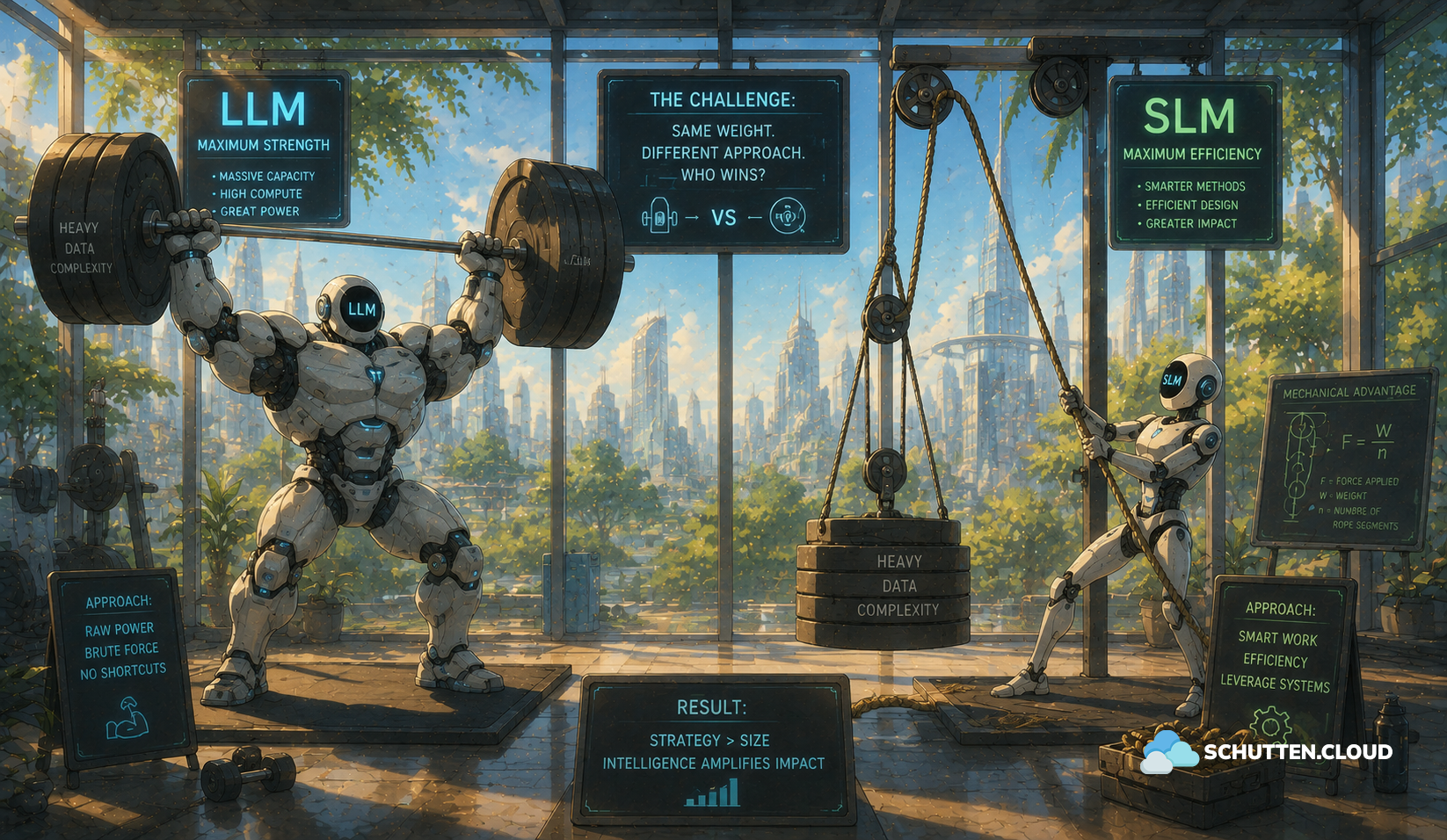
In the early days of generative artificial intelligence, tech companies believed one main rule: bigger is always better. Massive AI models like OpenAI's GPT-4, Google's Gemini Ultra, and Meta's Llama-3 proved that adding hundreds of billions of parameters unlocked incredible skills. These models could solve complex logic problems, write software, and translate languages easily. However, a new trend is taking over the tech world: Small Language Models (SLMs). Models such as Microsoft's Phi-3, Google's Gemma, and Meta's Llama-3-8B show that smaller models can also be smart, fast, and much cheaper to use. To understand the AI landscape today, models are generally divided into three main categories:Large Language Models (LLMs) [70B+ Parameters]: Massive models trained on huge amounts of internet data. They require powerful cloud servers to run and act as general-purpose experts. Medium Language Models [13B to 70B Parameters]: Balanced models that offer strong reasoning skills while still being easier for companies to host privately. Small Language Models (SLMs) [1B to 10B Parameters]: Compact models designed to run efficiently on small hardware, such as regular laptops, smartphones, or small internal company servers.Hardware constraints: Why model size matters To understand why SLMs are becoming so popular, we need to look at computer hardware, specifically graphics memory (VRAM) and speed. Memory requirements (VRAM) To run an AI model, its weights (parameters) must be loaded directly into a computer's high-speed graphics memory.A large 70-billion parameter model needs around 140 GB of VRAM to run at standard quality. This requires high-end enterprise hardware costing tens of thousands of dollars. In contrast, a small 8-billion parameter model can be compressed (quantized) to run using less than 5 GB of VRAM. This means it can easily run on a standard work laptop or a modern smartphone.Speed and latency Big models need to move massive amounts of data back and forth through hardware every time they generate a word. Smaller models carry much less data, which allows them to generate text much faster. This makes SLMs ideal for real-time tasks like live customer chat or typing assistance. How small models get so smart How can a small model perform almost as well as a giant model from a few years ago? The secret lies in high-quality data and smart training techniques. Traditional LLMs learn from raw internet text (billions of webpages, social media posts, and slang). Modern SLMs, on the other hand, learn from curated, high-quality "textbook" data and simplified lessons from larger models.Filtered Synthetic Data: Instead of learning from random internet chatter, modern SLMs are trained on clean, high-quality data created by larger AI models. This includes clear coding examples, textbooks, and step-by-step logic exercises. Knowledge Distillation: This is a process where a large "Teacher" model helps train a smaller "Student" model. The student learns to copy the reasoning patterns of the teacher without needing the giant memory size.Key differences at a glanceFeature Large Language Model (LLM) Small Language Model (SLM)Model Size 70B to 1 Trillion+ parameters 1B to 10B parametersHardware Needed Massive enterprise GPU servers Standard laptops, phones, single GPUsMemory Footprint Very High (100GB+ VRAM) Low (2GB to 10GB VRAM)Response Speed Slower for large answers Extremely fast generationOperating Cost High cloud API or server fees Very cheap to host locallyData Privacy Data usually sent to the cloud Data can stay fully on your local deviceCombining SLMs with company data (RAG) Many organizations assume they need a giant AI model to understand their company's internal files. However, using an AI model as a giant memory bank is inefficient and often leads to false answers (hallucinations). Instead, smart companies combine Small Language Models with a system called Retrieval-Augmented Generation (RAG):Step 1: User asks a question. Step 2: The system searches internal company documents for the facts. Step 3: The exact document text is given to the SLM. Step 4: The SLM reads the text and writes a clear answer.Because the SLM does not need to memorize all company facts inside its parameters, a small 8B model paired with RAG often outperforms a large, expensive LLM at a fraction of the cost. When to choose an LLM vs. an SLM Choosing the right model depends on your specific goals, budget, and privacy requirements. Choose a Large Language Model (LLM) when:You need complex reasoning: Writing complicated software code, analyzing vague legal documents, or solving advanced scientific problems. You build autonomous agents: AI systems that need to plan multiple steps and interact with external tools independently. Your queries are unpredictable: Your application covers many completely different subjects without a fixed focus.Choose a Small Language Model (SLM) when:Speed is critical: Applications like real-time translation, autocomplete, or instant customer support. Privacy is mandatory: Healthcare, finance, or legal tasks where data cannot leave the local building or device. You operate on a budget: Running high volumes of daily requests without paying expensive cloud API subscription fees.Closing thoughts Artificial intelligence is no longer just about building the largest possible model. While giant LLMs remain important for cutting-edge research and complex logic, Small Language Models are proving to be the most practical choice for daily business operations. By using clean training data, clever optimization, and targeted document systems, SLMs deliver fast, private, and cost-effective performance. The best AI architecture is not about using the biggest model available, but finding the smallest model that can solve your problem effectively.
- Rolf Schutten
- 16 Aug, 2026
The AI productivity paradox: Why more tools aren't saving us time
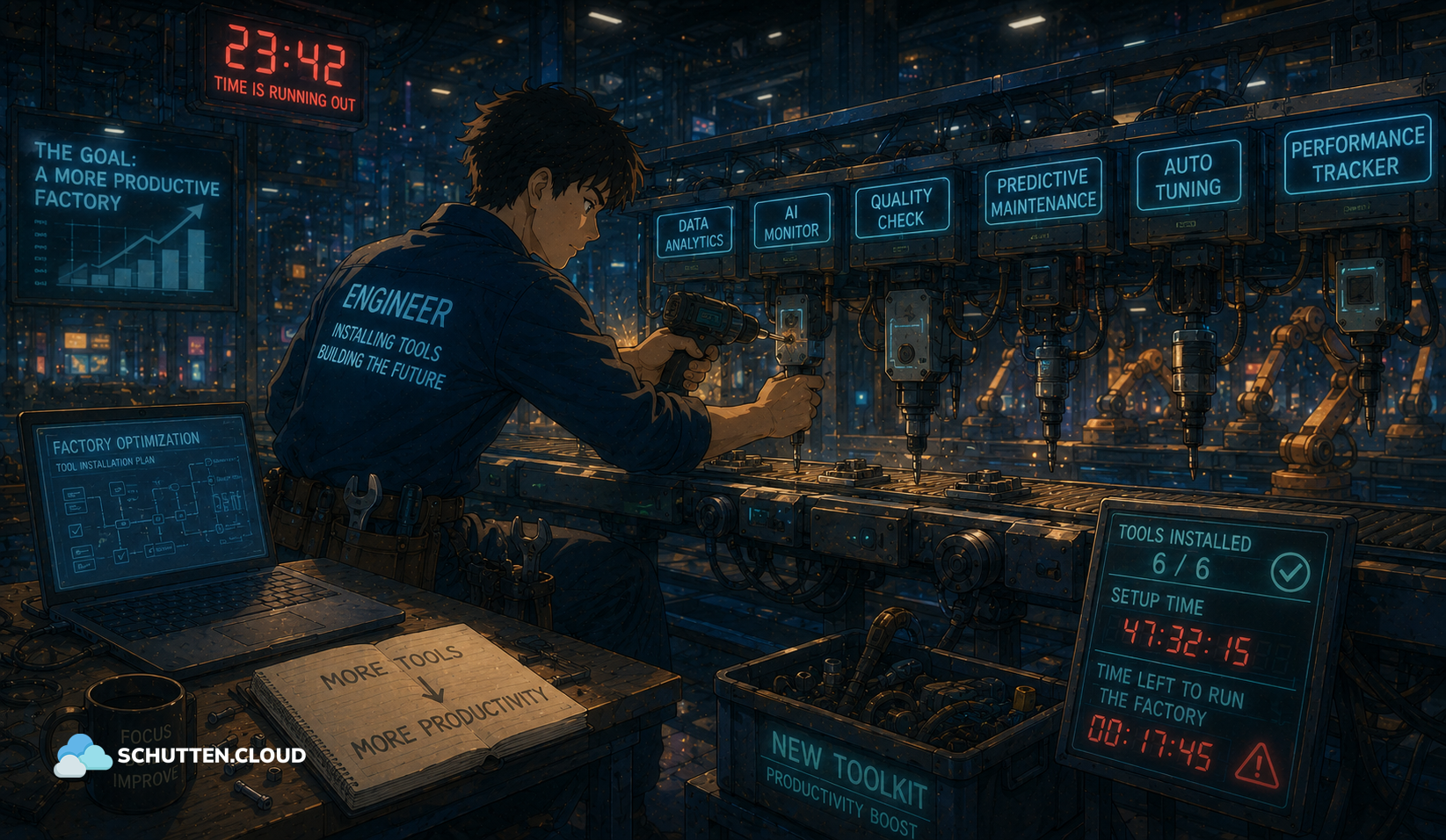
Artificial intelligence has spread faster than almost any other technology in human history. Today, workers across every industry use generative AI daily. They use it for writing reports, designing presentations, writing software, and summarizing long meeting notes. Major software companies have embedded AI directly into our email clients, office suites, and project dashboards. On paper, this should save us hours of work every week. Yet, if you look at modern business statistics, overall productivity has barely moved. Many business leaders are left asking the same frustrating question: If everyone is using AI, why is work not getting done any faster? This situation is not actually new. It is a modern version of the famous "productivity paradox" observed by economist Robert Solow in the 1980s. Back then, he noted that computers were visible everywhere except in the economic productivity numbers. Today, AI faces the exact same challenge. Why AI saves minutes, not whole processes The main reason for this productivity gap is simple: most people use AI to speed up small, isolated tasks rather than fixing full workflows. For example, a customer service agent might use AI to draft a quick reply to an email. The drafting takes five seconds instead of five minutes. However, that message still needs manual review, manager approvals, and input into old database systems. The bottleneck simply moves to another part of the process. In addition, several hidden time-wasters prevent AI from delivering its full potential:The Double-Checking Burden: AI outputs are rarely perfect on the first try. Employees end up spending significant time checking facts, correcting hallucinations, and editing formatting. Tool Overload: Organizations often use multiple specialized AI tools at the same time, such as ChatGPT, Claude, Midjourney, and GitHub Copilot. Deciding which tool to use and switching between them creates mental fatigue. The "More Content" Trap: Because creating documents and emails has become easier, companies generate much more of them. This creates a massive ocean of reports and emails that other employees must spend time reading. Constant Context Switching: Workers constantly jump between Slack messages, email, AI chats, and project boards, which drains mental energy throughout the day.What history teaches us about real efficiency MIT economist Erik Brynjolfsson points out that groundbreaking technologies rarely boost productivity immediately. He compares the current adoption of AI to the arrival of electricity in factories during the late 19th century. When factory owners first replaced steam engines with electric motors, productivity did not go up right away. It was only when they completely redesigned factory layouts and assembly lines around electricity that output exploded. Old Approach: [Standard Process] + [Add AI Tool] = Minimal Time Saved New Approach: [Redesigned Process Built for AI] = Massive EfficiencySimilarly, Wharton professor Ethan Mollick emphasizes that AI works best as a collaborative partner rather than a basic tool. Companies that see massive productivity gains do not just give their workers an AI login; they fundamentally rethink how work gets done. Real-world example: Support & software developmentCustomer Support: Instead of using AI just to suggest email templates, leading companies let AI agents sort tickets, handle routine queries autonomously, and route complex edge cases directly to human experts. Software Engineering: Rather than using AI merely to write single lines of code, teams integrate AI across the whole cycle—from initial architecture planning and automated unit testing to security checks and documentation.Looking ahead: The shift to autonomous agents We are currently moving from simple AI assistants toward autonomous AI agents. New multimodal agentic systems—like Alibaba’s Qwen 3.7 Plus—can look at user interfaces, click buttons, navigate websites, and complete multi-step tasks across different software without constant human prompting. As these tools mature and become affordable to deploy, the central question for businesses will change. It will no longer be "Should we use AI?" but rather "How must we redesign our work to let AI perform whole tasks effectively?" Closing Thoughts Having access to the most powerful AI tools in the world will not automatically make your team faster or smarter. Technology only provides the raw capability; real success depends on how thoughtfully you restructure your daily habits, workflows, and organizational structures to support it. True productivity in the AI era is not about doing old tasks faster. It is about designing completely new ways of working.

- Rolf Schutten
- 15 Aug, 2026
Stop using engineers as shock absorbers
Look at almost any modern tech job advertisement today, and you’ll see the exact same list of benefits: “Flexible hybrid work, autonomous culture, latest hardware, and regular team events.” Yet, despite these perks, tech companies worldwide face a persistent crisis: their highest-performing senior engineers and tech leads are silently walking out the door. Industry data confirms this gap. According to global developer experience benchmarks, over 65% of senior engineering turnover is driven by organizational friction and administrative noise, rather than technical difficulty or compensation. Developers do not quit because of a lack of team socials or fruit baskets. They leave when their day-to-day job becomes buffering their team against executive indecision, sitting in low-value alignment meetings, and blunting structural chaos. The "Human shock absorber" In many growing software organizations, a subtle leadership failure occurs as teams scale. When executive boards struggle to establish clear strategic boundaries or resolve cross-departmental friction, they quietly delegate that responsibility downward. They create what can only be called a Frankenstein Role: a Tech Lead or Staff Engineer who is asked to be 100% hands-on architect, 100% people coach, and 100% process firefighter. Instead of solving complex technical problems or building scalable cloud architectures, your highest-paid technical experts become human shock absorbers. They spend up to half their working week absorbing leadership noise, translating vague goals, and mediating conflicts that should have been settled at the C-level. Research on developer cognitive load shows that modern software engineers spend less than 30% of their actual workday writing code or designing software. The remaining time is consumed by context-switching, status updates, and navigating organizational friction. The real math behind senior engineering turnover When a burned-out senior engineer or lead resigns from a bloated role, the financial damage on the P&L statement is far larger than most executives realize. The true total cost of losing a key technical figure can be broken down using standard engineering talent benchmarks:Cost Category Impact Level DescriptionDirect Replacement Costs Significant Agency fees, interviewing hours, sign-on packages, and competitive market salaries for senior talent.Onboarding & Ramp-Up Substantial Lost productivity during the 6 to 9 months it takes a new senior engineer to master a complex codebase.Contagion Effect (Domino Turnover) High Risk McKinsey research shows that when a respected lead quits, team members are up to 35% more likely to leave within 6 months due to increased workload and chaos.Roadmap & Market Delay Severe Slid delivery dates, delayed feature releases, and missed market opportunities.Plaguing your organization with high turnover isn't a recruitment issue—it is a direct leadership leak. You can't code out of broken governance With the rapid adoption of AI coding assistants, agentic dev-tools, and automated testing suites across engineering teams, leadership teams often assume tech investments will solve their productivity bottlenecks. However, recent studies on AI engineering adoption highlight a clear contradiction: While AI assistant tools improve individual line-of-code generation by 15% to 20%, total organizational delivery velocity in chaotic companies improves by less than 3%.Why? Because generating code was never the primary bottleneck. If your decision-making process is slow, your boundaries are blurry, and your teams are misaligned, AI tools simply help your developers build the wrong things faster. Buying AI licenses to compensate for poor organizational design is one of the most expensive escape routes on an IT balance sheet. You cannot solve a structural leadership deficit with a software subscription. How to sanitize your engineering leadership Restoring execution speed and retaining top-tier engineering talent requires structural clarity at the top. You don't need another soft skills workshop, agile transformation, or internal culture initiative. You need clean leadership architecture: 1. Keep C-suite accountabilities at C-level Executives must set firm strategic priorities, establish binary boundaries, and clean up inter-departmental politics. Never ask a Tech Lead or Engineering Manager to resolve organizational friction without giving them explicit executive authority. 2. Ruthlessly separate technical roles from line management Stop expecting senior engineers to be elite software architects and full-time people managers simultaneously. Create clear, parallel career tracks:Individual Contributor (IC) Track: Focused 100% on architecture, technical execution, and code quality. Engineering Management Track: Focused on people development, resource allocation, and team enablement.3. Measure friction, not just output Instead of tracking raw output or ticket velocity, measure organizational friction:How many hours a week do senior leads spend in alignment meetings? How often do decisions made at the top get reopened three weeks later? How long does it take to get a clear 'yes' or 'no' on technical decisions?Closing thought Senior A-players in software engineering do not leave companies because the work is hard. They leave when the work is made unnecessarily chaotic by a lack of leadership structure. The next significant improvement to your bottom line and product delivery won't come from a new framework, a recruitment drive, or another AI tool. It will come from eliminating the hidden operational friction that is draining your lead engineers today. Ask yourself: Is your executive team providing clear boundaries for your engineers to build great products, or are you using them as human shock absorbers for organizational noise?

- Rolf Schutten
- 13 Aug, 2026
From waiting too long to moving ahead: Why Cbw and AI governance need one clear plan.
In the Netherlands, waiting until the very last moment to deal with new rules is very common. For a long time, the standard approach to IT security was simple: "They won't check us yet," or "Let's wait and see what others do." With the European NIS2 directive and the new Dutch cybersecurity law — the Cyberbeveiligingswet (Cbw) — that time is over. The laws are active, supervision is starting, and the final responsibility now sits directly with company directors and executive management. Viewing the Cbw as just a burden or a boring checklist is a mistake. At the same time, the EU AI Act and frameworks like ISO 42001 are coming at us fast. Treating these as completely separate projects will waste budget and burn out your team. The smartest move is to stop waiting and combine IT security and AI governance into one clear strategy. The Cyberbeveiligingswet (Cbw): Why waiting is no longer an option The goal of NIS2 and the Cbw is simple: raise the basic level of digital security across Europe. The old rules mostly applied to traditional vital sectors like energy and water. The new Cbw applies to many more organizations. Medium and large companies in logistics, food, chemistry, digital services, and IT providers (MSPs and MSSPs) now fall under the law. Because of this, supply chain security becomes a shared legal responsibility. Two core parts of the Cbw change how companies must operate:Duty of Care & Fast Reporting: Companies must prove they take the right technical and organizational security steps. If a major incident happens, strict rules apply: a first warning must be sent to regulators within 24 hours. Personal Board Responsibility & Mandatory Training: Directors can now be held personally responsible if they ignore basic security rules. On top of that, executives are legally required to take regular training to understand cyber risks. Leaving IT security completely to the IT department without director oversight is no longer allowed by law.BIO2 becomes law: Your foundation is already there For Dutch government bodies and their IT suppliers, an important change is happening. The Baseline Informatiebeveiliging Overheid (BIO2) is moving from a voluntary framework to a binding law under the Cyberbeveiligingsbesluit. While many organizations worry about this, the truth is that BIO2 gives you a solid foundation you might already own. It builds on well-known global standards:ISO/IEC 27001: The process foundation for security management (ISMS). It sets up risk checks, policies, and continuous improvement. CIS Controls: The practical, technical checklist. Where ISO tells you what goals to reach, CIS Controls give you a concrete list of actions (device management, multi-factor authentication, logging, and endpoint protection).If your organization already works with ISO 27001 or BIO2, you already cover most of the technical requirements of the Cbw. The AI side: Don't build another separate project At the same time, company boards are hearing about the EU AI Act and ISO 42001 (the standard for Artificial Intelligence management). The usual reaction is to push AI away: "Let's finish the Cbw project first. We will worry about AI in a few years." This is a missed opportunity. If you compare BIO2 and ISO 27001 with ISO 42001, you see something interesting: a company running a good ISO 27001 or BIO2 setup already covers 70% to 80% of what ISO 42001 requires. That is because AI management uses the exact same basics as normal IT security: risk checks, data rules, access management, supplier controls, and incident handling. You do not need to build a whole new management system. The specific "AI gap" The remaining 20% to 30% gap is very specific:AI Ethics & Fairness: Making sure algorithms work fairly without discrimination. Explanation & Human Control: Understanding how an AI tool reaches a decision and keeping a human in control (human-in-the-loop). Impact on People: Checking how the AI tool affects employees, customers, and privacy. AI Lifecycle Management: Checking data quality and monitoring if the AI model changes over time (data drift). AI Incident Handling: Preparing for new threats like prompt injection or accidental data leaks through AI tools.These extra steps are not a new system; they are just a direct addition to your current IT security setup. One integrated plan: Build it once The AI Act timeline moves forward regardless of your Cbw deadlines. Companies that treat these things as three separate projects — one for Cbw, one for ISO 27001, and one for AI — will pay three times as much for the same result. The practical order to follow is: BIO2 / ISO 27001 Foundation ➡️ CIS Controls (Technical Setup) ➡️ ISO 42001 (AI Extension) Practical steps to takeCombine Risk Checks: Add AI tools and algorithms directly to your existing risk lists in your security management system. Use Clear Technical Rules: Use CIS Controls to secure your cloud environments (like Microsoft Azure) to meet the requirements for both Cbw and ISO standards. Extend Your Security Policies: Add the specific ISO 42001 points for AI ethics and control directly into your daily processes. Train the Board: Combine the required Cbw training for directors with a practical update on AI risks and opportunities.Closing thoughts Putting off rules and regulations until the last minute no longer works. The Cyberbeveiligingswet, mandatory BIO2 rules, and the EU AI Act mean that IT security and AI are now direct topics for company leadership. Instead of running separate compliance projects, combining these standards into one clear plan turns a legal obligation into a practical advantage. You protect directors from liability, remain a trustworthy partner in your supply chain, and build a safe foundation to use AI effectively in your business.

- Rolf Schutten
- 11 Aug, 2026
The involuntary digital citizen: How public systems expose private lives.
There was a time when using the internet was a choice. You logged on to send an email, read the news, or order a product. If you didn't trust a website, you simply closed your browser. Today, that choice no longer exists. If you want to file your income tax, view your medical lab results, apply for student support, or register a business, you are forced to use a digital platform. Governments and public institutions across Europe, the United Kingdom, and North America call this "digital transformation" and "efficiency." However, technical investigations reveal an uncomfortable truth: public digital platforms silently leak sensitive citizen data to commercial advertising networks, data brokers, and global tech corporations. Because you cannot opt out of paying taxes or seeking medical care, you are no longer just a citizen using a public service. You have been turned into an involuntary data provider. The illusion of voluntary consent Modern privacy regulations like the GDPR in Europe or the CCPA in California are built on a simple promise: consent. Companies must ask for your permission before collecting your data, and you have the right to say no. When applied to public services, this promise breaks down completely. Consent requires a genuine choice. But consider what happens when a citizen tries to opt out of public digital systems:Refuse a digital portal? You face administrative delays, physical office visits during work hours, or financial penalties. Refuse a health app? You lose direct access to your test results, prescriptions, and appointment schedules. Refuse digital identity verification? You are locked out of essential state benefits and civic rights.When saying "no" results in social or financial exclusion, consent is no longer voluntary. It is forced. Public platforms place cookie banners on their websites and act as if citizens have made a free choice. But clicking "accept" when you have no alternative is not consent. It is compliance. Public portals on foreign clouds One of the main reasons public data leaks so easily is that governments rarely build or operate their own digital infrastructure. Instead, they outsource their systems to global cloud platforms and commercial software vendors. This creates structural dependencies that few public institutions can control.Domain What Citizens See What Happens Behind the ScreenTax & Benefits Official state login portals Analytics scripts and tracking pixels measure payment behavior and session length.Healthcare Patient portals and medical apps Third-party cloud hosts process health records under extra-territorial legal regimes.Crisis Support Helplines and mental health sites Session recording tools track mouse clicks and text fields in real time.When a tax authority or public health service runs its infrastructure on cloud providers owned by foreign corporations, that data becomes subject to laws like the US CLOUD Act. This law allows foreign law enforcement agencies to demand access to data stored on systems owned by domestic companies, regardless of where the physical server is located. Furthermore, technical audits of government websites frequently discover commercial tracking tools—such as Google Tag Manager or Adobe Analytics—embedded directly into payment flows and application forms. What starts as an official interaction between a citizen and their government quietly turns into a data stream for third-party ad networks. Surveillance at our most vulnerable The failure of data protection becomes even more serious in the healthcare and welfare sectors. This is where citizens interact with the state during their most vulnerable moments. Consider crisis helplines and mental health platforms. Investigations across multiple countries have revealed that third-party trackers were active on suicide prevention websites and emergency mental health portals. Search terms, location data, and visits to specific support pages were transmitted to commercial analytics vendors. Another widespread practice is the use of "Session Replay" software on public health and charity portals. These tools record a visitor's screen experience in real time. They capture mouse movements, clicks, and even text typed into form fields before the user presses "submit." When someone enters sensitive personal information while searching for debt relief, mental health support, or medical advice, that interaction should be private by default. Instead, it is recorded, analyzed, and stored on external servers operated by third-party vendors. The low-tech reality of public breaches When governments force citizens to surrender their personal data, they have a strict responsibility to protect it. Yet public sector cybersecurity is frequently weakened by outdated systems, lack of technical understanding, and basic operational errors. Data leaks in the public sector rarely require sophisticated state-sponsored hackers. More often, they happen because of fundamental mistakes:Redaction errors: Official documents are routinely published with black shapes placed over sensitive names and addresses in PDF editors, leaving the underlying text readable and easy to copy. Misconfigured storage: Databases containing scanned passports, driver's licenses, and tax records are regularly discovered sitting on open cloud storage without basic authentication. Unmanaged API endpoints: Public applications often expose internal data interfaces that allow unauthorized users to request citizen records without proper authorization checks.These leaked records do not stay isolated. Data brokers combine scattered data points to build detailed profiles on millions of people. When your phone number, home address, and tax information leak from a public database, that information is quickly weaponized. It directly fuels targeted phishing campaigns, identity theft, and bank impersonation fraud against unsuspecting citizens. Sovereignty cannot be bought with a cookie banner Many public institutions believe that placing a privacy banner on their website or passing a compliance checklist means their platform is secure. This misses the point. Privacy is not a legal statement added to a website after it is built. It is an architectural constraint that must shape how systems are designed from the start. There is a profound asymmetry of power in digital government:The state demands complete transparency from the citizen (income, health status, living situation, identity). The state offers almost no transparency about where that data flows, which vendors process it, or who has access to it.When privacy watchdogs discover these violations, the response is usually an administrative warning or a fine. But when a public agency pays a privacy fine, it pays that fine using taxpayer money. The citizen pays twice: first with their data, and then with their tax money to settle the fine. The real cost of forced digitalization Digital progress should make life simpler without stripping people of their basic rights. When public services make digital interaction mandatory, they create a system where citizens are forced to trade their personal privacy for access to society. You cannot choose another tax authority. You cannot choose another national healthcare system. You have no market choice. If governments insist on digital-first public services, they must guarantee true digital sovereignty. That means public platforms built on open, audited, locally controlled infrastructure—completely free from commercial tracking, third-party profiling, and foreign jurisdiction. Until that happens, digital citizenship is not an upgrade. It is an obligation. Closing thought The argument "I have nothing to hide" completely fails when you do not know where your data goes, who profits from it, or how it might be used against you in the future. Privacy is not a feature you turn on in a settings menu. It is not a luxury for people who have the time and money to avoid digital channels. Privacy is a fundamental human right. A government that demands complete transparency from its citizens while offering complete opacity in its technology is no longer serving its people—it is monitoring them.

- Rolf Schutten
- 08 Aug, 2026
The tech literacy crisis: Why we are raising a generation unprepared for the real world
A worrying trend has been growing in secondary education over the past twenty years. In many middle schools, practical technology classes have quietly disappeared or seen their hours cut by more than half. This might look like a simple change in school schedules. But in reality, it shows a huge gap between what we teach our children and what our modern world actually needs. We are raising a generation that uses touchscreens every day, but has no basic understanding of how those devices are powered, built, or programmed. The big contradiction of our time We live in a world that relies heavily on fast technological growth. Almost every major challenge we face today requires real technical skills. We need:Energy transition experts to build solar grids, manage battery storage, and run modern power plants. Electronics and hardware engineers to design microchips, PCBs, and robotics. Software developers and cybersecurity specialists to keep our digital networks safe. Industrial construction engineers to build sustainable houses and modern factories.The demand for these technical specialists is higher than ever. Yet, our education system treats basic technology lessons like an optional hobby instead of an essential core subject. We expect young people to choose technical careers later in life, even though they barely get to touch practical engineering during their school years. From creators to passive consumers By removing technology education from schools, we create a passive mindset. When students never get the chance to open a circuit board, build a simple frame, or write basic code, they start viewing technology purely as consumers. They treat complex machines as black boxes—magic objects that just work until they break. A strong economy cannot rely only on consumers. It needs builders, fixers, and creators. Understanding basic technology—like electric circuits, mechanical parts, and software logic—is no longer just for future mechanics. It is a basic skill everyone needs in a high-tech world. The danger for future leadership This lack of basic technical knowledge also creates a problem in the workplace. When general technical knowledge drops, the gap between management and technical execution grows wider. Companies end up led by managers who understand spreadsheets, but have no idea how their company's physical or digital products actually work. As a result, organizations struggle to innovate. They make wrong estimations about timelines, underestimate technical challenges, and fail to understand their own engineers. If we want smart, tech-savvy leaders in boardrooms tomorrow, we must introduce children to practical technology today. Bringing practical technology back to school Fixing this problem does not mean every student needs to become a software developer or a nuclear engineer. It simply means treating technology education with the same respect as math, history, or language. We need to teach young people how the world around them works. That means bringing practical technology back to the classroom:Combine theory with practice: Teach math and physics using real-world technical problems. Remove the mystery: Give students the confidence to take things apart, fix problems, and build new things. Show real career paths: Help students see early on what modern jobs in software, energy, and building actually look like.Closing thought We cannot build a high-tech future on a foundation of low-tech education. If we want to maintain our infrastructure, succeed in the energy transition, and stay competitive, we must take technology education seriously again. It is time to give the next generation the practical skills, curiosity, and knowledge they need to build the future.

- Rolf Schutten
- 01 Aug, 2026
The promise was freedom. What we got was an algorithm that stopped us from dancing.
I am 35 years old today, and most people my age don't have children. Think about that for a moment. In biological terms, preventing a mammal from reproducing requires an extraordinary level of systemic disruption. Biologically, naturally, life seeks to perpetuate itself. Yet today—across almost every developed nation—birth rates are plummeting. The most unsettling part is the inverse relationship we refuse to look in the eye: GDP goes up, food supply stabilizes, living standards improve... and people stop having babies. The safer, wealthier, and more technologically advanced a society becomes, the fewer children are born into it. This isn't an anomaly in a single country. It is a global trend. And it isn't happening by accident. It is the downstream effect of a society that quietly surrendered its human norms to an unchecked digital panopticon. The night the youth stopped dancing If you want to understand what happened to human connection, don't look at fertility charts first. Go to a nightclub. Or rather, look at what used to be one. When you're 18 today and step into a club, nobody really dances anymore. Nobody lets go. Why? Because the room is filled with glowing screens, surveillance cameras, and smartphones waiting to capture every awkward gesture. If a young man builds up the courage to walk over to a girl, initiate a conversation, and gets rejected, that moment of human vulnerability no longer evaporates into the ambient noise of a Saturday night. It gets recorded. It gets uploaded. It gets analyzed, mocked, and monetized. We have turned the physical world into a digital panopticon. Every social risk now carries a permanent digital record. Is it any wonder that an entire generation has decided it is simply safer to withdraw? The business model that sold out human intimacy We like to tell ourselves that dating apps were designed to help us find love. That is a comforting lie. Dating algorithms do not optimize for you finding a lifelong partner. If you meet the love of your life today, you delete the app. You stop clicking. You stop generating ad impressions. You stop paying for premium subscriptions. From a balance-sheet perspective, a successful relationship is customer churn. So what do the algorithms optimize for instead? Engagement. Retention. Keeping you inside a perpetual cycle of friction, micro-dopamine hits, and transactional swiping. Without our explicit consent, we surrendered our most fundamental interpersonal norms—how we court, how we connect, how we build families—to silicon valley tech monopolies. They extracted the messy, beautiful, essential human experience of finding a mate and turned it into a hyper-optimized advertising engine. And we, as a society, just watched it happen. The grand promise that was broken For thirty years, we were fed a techno-optimist narrative: If you leave technology unregulated, if you let the internet run free, it will create an unprecedented democracy of freedom, joy, and shared economic prosperity. Where is that freedom? Who actually inherited that joy? My generation grew up watching this promise shatter in real-time. We didn't regulate. We didn't build proper oversight. Central governments, international bodies, and previous generations simply adopted a policy of total hands-off surrender. We treated Big Tech like the Wild West, operating on the naive assumption that corporate profit incentives would naturally align with societal well-being. They didn't. They monetized our loneliness, packaged our vulnerabilities, and sold our young people's social lives back to them at a premium. What happens when we repeat the mistake with AI? This isn't just an post-mortem on social media and dating apps. It is an urgent warning about where we are heading right now. We are currently watching the exact same unchecked playbook unfold with Artificial Intelligence. Once again, technology is operating as the Wild West. Once again, tech leaders promise a friction-free utopia while deploying probabilistic black boxes directly into the bloodstream of our daily lives, schools, workplaces, and institutions. We failed to be proper custodians of the internet era. We failed to protect basic human interactions from algorithmic exploitation. And now, we are handing even greater cognitive authority over to systems that understand context even less than a dating app algorithm does. Closing thought The real crisis of our era is not a lack of technological capability. It is a profound lack of courage in governing it. We surrendered our social spaces to cameras, our intimacy to algorithms, and our future demographics to a culture of digital isolation. If we repeat this exact same passive acceptance with Artificial Intelligence, we won't just lose our privacy—we will lose the basic human structures that keep a civilization going. Technological progress without human stewardship isn't progress. It is just a very efficient way to build a world where nobody dances.