Large vs. Small Language Models: Understanding the differences and choosing the right tool
 Rolf Schutten
- 18 Aug, 2026
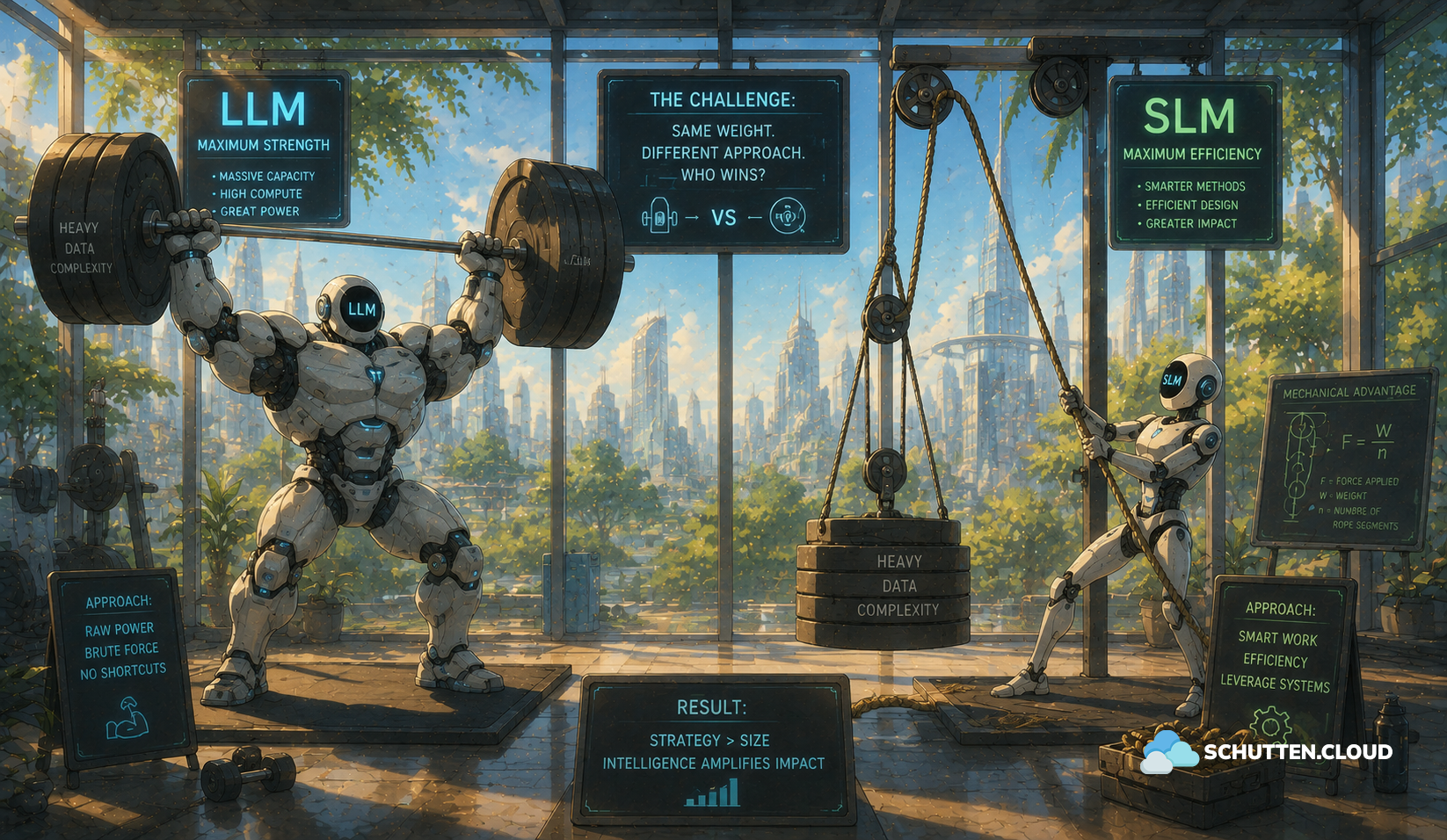
In the early days of generative artificial intelligence, tech companies believed one main rule: bigger is always better. Massive AI models like OpenAI’s GPT-4, Google’s Gemini Ultra, and Meta’s Llama-3 proved that adding hundreds of billions of parameters unlocked incredible skills. These models could solve complex logic problems, write software, and translate languages easily.
However, a new trend is taking over the tech world: Small Language Models (SLMs). Models such as Microsoft’s Phi-3, Google’s Gemma, and Meta’s Llama-3-8B show that smaller models can also be smart, fast, and much cheaper to use.
To understand the AI landscape today, models are generally divided into three main categories:
- Large Language Models (LLMs) [70B+ Parameters]: Massive models trained on huge amounts of internet data. They require powerful cloud servers to run and act as general-purpose experts.
- Medium Language Models [13B to 70B Parameters]: Balanced models that offer strong reasoning skills while still being easier for companies to host privately.
- Small Language Models (SLMs) [1B to 10B Parameters]: Compact models designed to run efficiently on small hardware, such as regular laptops, smartphones, or small internal company servers.
Hardware constraints: Why model size matters
To understand why SLMs are becoming so popular, we need to look at computer hardware, specifically graphics memory (VRAM) and speed.
Memory requirements (VRAM)
To run an AI model, its weights (parameters) must be loaded directly into a computer’s high-speed graphics memory.
- A large 70-billion parameter model needs around 140 GB of VRAM to run at standard quality. This requires high-end enterprise hardware costing tens of thousands of dollars.
- In contrast, a small 8-billion parameter model can be compressed (quantized) to run using less than 5 GB of VRAM. This means it can easily run on a standard work laptop or a modern smartphone.
Speed and latency
Big models need to move massive amounts of data back and forth through hardware every time they generate a word. Smaller models carry much less data, which allows them to generate text much faster. This makes SLMs ideal for real-time tasks like live customer chat or typing assistance.
How small models get so smart
How can a small model perform almost as well as a giant model from a few years ago? The secret lies in high-quality data and smart training techniques. Traditional LLMs learn from raw internet text (billions of webpages, social media posts, and slang). Modern SLMs, on the other hand, learn from curated, high-quality “textbook” data and simplified lessons from larger models.
- Filtered Synthetic Data: Instead of learning from random internet chatter, modern SLMs are trained on clean, high-quality data created by larger AI models. This includes clear coding examples, textbooks, and step-by-step logic exercises.
- Knowledge Distillation: This is a process where a large “Teacher” model helps train a smaller “Student” model. The student learns to copy the reasoning patterns of the teacher without needing the giant memory size.
Key differences at a glance
| Feature | Large Language Model (LLM) | Small Language Model (SLM) | |||||||
|---|---|---|---|---|---|---|---|---|---|
| Model Size | 70B to 1 Trillion+ parameters | 1B to 10B parameters | |||||||
| Hardware Needed | Massive enterprise GPU servers | Standard laptops, phones, single GPUs | |||||||
| Memory Footprint | Very High (100GB+ VRAM) | Low (2GB to 10GB VRAM) | |||||||
| Response Speed | Slower for large answers | Extremely fast generation | |||||||
| Operating Cost | High cloud API or server fees | Very cheap to host locally | |||||||
| Data Privacy | Data usually sent to the cloud | Data can stay fully on your local device |
Combining SLMs with company data (RAG)
Many organizations assume they need a giant AI model to understand their company’s internal files. However, using an AI model as a giant memory bank is inefficient and often leads to false answers (hallucinations).
Instead, smart companies combine Small Language Models with a system called Retrieval-Augmented Generation (RAG):
- Step 1: User asks a question.
- Step 2: The system searches internal company documents for the facts.
- Step 3: The exact document text is given to the SLM.
- Step 4: The SLM reads the text and writes a clear answer.
Because the SLM does not need to memorize all company facts inside its parameters, a small 8B model paired with RAG often outperforms a large, expensive LLM at a fraction of the cost.
When to choose an LLM vs. an SLM
Choosing the right model depends on your specific goals, budget, and privacy requirements.
Choose a Large Language Model (LLM) when:
- You need complex reasoning: Writing complicated software code, analyzing vague legal documents, or solving advanced scientific problems.
- You build autonomous agents: AI systems that need to plan multiple steps and interact with external tools independently.
- Your queries are unpredictable: Your application covers many completely different subjects without a fixed focus.
Choose a Small Language Model (SLM) when:
- Speed is critical: Applications like real-time translation, autocomplete, or instant customer support.
- Privacy is mandatory: Healthcare, finance, or legal tasks where data cannot leave the local building or device.
- You operate on a budget: Running high volumes of daily requests without paying expensive cloud API subscription fees.
Closing thoughts
Artificial intelligence is no longer just about building the largest possible model. While giant LLMs remain important for cutting-edge research and complex logic, Small Language Models are proving to be the most practical choice for daily business operations. By using clean training data, clever optimization, and targeted document systems, SLMs deliver fast, private, and cost-effective performance.
The best AI architecture is not about using the biggest model available, but finding the smallest model that can solve your problem effectively.