
 Rolf Schutten
- 20 Aug, 2026
Why leaders shouldn't give weight to every battle
As a leader, you are constantly surrounded by information, conflicts, opinions, and unexpected events. It feels natural to address everything that lands on your plate. However, there is a fundamental rule in leadership that many overlook: your reaction creates reality. When you choose to respond to a situation, you publicly give it weight. You acknowledge that it is real, important, and worthy of attention. But what happens when you react to the wrong things? Understanding when to step into the ring and when to pretend you didn't see a thing is one of the most critical skills a leader can master. The hidden danger of acknowledging everything It is tempting to believe that a good leader handles every problem directly. But acknowledging every minor conflict, provocation, or mistake can backfire quickly. When you validate every issue by responding to it, two things happen:You give up your power: If you constantly react to what others do or say, you let them set your agenda. You become reactive instead of strategic. You risk looking weak or submissive: Formally acknowledging minor politics or small attacks can make you look defensive. It shows that those small things can easily disturb you.If you react to every small distraction, you erode your own authority and mandate. You waste precious energy on noise instead of focusing on long-term impact. When to "play dumb" Sometimes, the most powerful response is no response at all. In management, choosing not to see or hear something—turning a blind eye—can be a strong tactical move.It starves negative energy: Small drama and minor provocations rely on oxygen. If you don't give them attention, they usually fade away on their own. It preserves focus: Your team watches what you pay attention to. If you focus on small details, they will too. If you ignore the noise, they stay focused on the real work. It maintains your position: By ignoring trivial issues, you signal that certain low-level behavior is simply beneath your level of engagement.Act or ignore? Before you jump into action, ask yourself these three filtering questions: 1. Does this threaten our core values or strategic goals? If a situation directly harms team safety, ethics, or main targets, you must act firmly and immediately. Leaving these issues unaddressed damages your credibility. 2. Am I reacting out of ego or true necessity? If someone makes a light remark or questions your stance, ask yourself if your ego is just feeling hurt. If there is no real impact on the business, let it go. 3. Will my reaction solve the problem or just amplify it? Sometimes, bringing an issue into the spotlight creates a bigger crisis than the original problem. If acknowledging an event makes your position weaker or subordinate, step back. Protecting your mandate and authority Leadership is not about fighting every battle; it is about choosing which battles are worth winning. When you are selective with your energy, your team learns that when you do speak or act, it truly matters. By refusing to acknowledge small, distracting realities, you protect your authority and stay in control of the narrative. Closing Thoughts Mastering the balance between action and silence takes practice. Acknowledge what builds your team and advances your mission. Ignore the noise that drags you into petty politics. Your authority does not come from controlling every detail, but from directing your focus toward what truly lasts. True authority is not shown by responding to everything, but by choosing what truly deserves your energy.

- Rolf Schutten
- 19 Aug, 2026
Why saying 'no' is the only sustainable choice
Many operational leaders recognize this scenario: you return from vacation and discover that important decisions were made informally over coffee. Official rules were ignored, and there is no proper handover. Suddenly, an urgent executive presentation lands on your desk with a 48-hour deadline. Your first instinct is likely to work overtime and clean up the mess. It feels helpful, useful, and necessary. However, stepping in to fix everything is the worst thing you can do. Leadership expert Bas Kodden explains in his book The Devil Inside that you end up sabotaging yourself and your organization. When you solve problems caused by poor leadership, you hide the real damage of broken agreements and keep the chaos alive. To build a healthy organization, you must face the truth: you have to stop helping. The trap of self-sabotage Why is it so hard to say "no"? Why is our default reaction always a stressed "yes"? It comes down to internal "saboteurs" or emotional triggers:Fear: Fear of conflict, fear of appearing unhelpful, or fear that everything will fall apart if you do not step in. Empathy: Excessive sympathy for desperate colleagues, which causes you to take on their pressure and stress. Ego: The desire to be the hero who saves the day, or the fear of feeling guilty.Because of these triggers, we constantly compensate for broken processes. True leadership starts with self-leadership: leading yourself first. You need to reflect on these emotional traps and stop making excuses for poor planning. Why "no" is the most sustainable choice Saying "no" to artificial urgency is not selfish or unhelpful. It is the most sustainable choice for your team and organization. When you decline an unplanned request, three positive things happen:The problem stays with the owner: The person who ignored rules or failed to plan feels the direct consequences, which encourages better behavior next time. You protect your team: You save your team's energy and capacity for planned operational goals. Governance is restored: Declining informal requests forces managers to use official decision-making channels.7 Rules for operational boundaries Saying "no" requires self-control. Use these seven practical rules to evaluate last-minute requests:No goal means "no": If the request does not directly support agreed goals, it is not a priority. Urgent is not always important: Someone else's panic usually means poor planning. Do not make it your problem. Look at hidden costs: Every extra task takes time. Ask yourself: Which important goal must I sacrifice for this? Saying "yes" to chaos means saying "no" to strategy: Time is limited. Last-minute work always hurts the quality of your core duties. Take time to pause: Stop reacting automatically. Take a moment to think before giving a clear answer. Let your calendar decide: If the task does not fit into your schedule, the calendar makes the decision for you. Demand context first: Ask for the business objective and proper approval. Often, you will find the request was not necessary after all.Closing thoughts An organization cannot grow on heroic acts, overtime, and personal favors. Sustainable success comes from clear agreements, structured roles, and respect for operational boundaries. Once you learn to manage fear, ego, and excessive empathy, you realize that saying "no" is not a rejection—it is professional respect. It forces the organization to mature and protect its own systems. Stop helping. Start protecting the system. Saying "no" to artificial chaos is the most sustainable choice you can make.
- Rolf Schutten
- 18 Aug, 2026
Large vs. Small Language Models: Understanding the differences and choosing the right tool
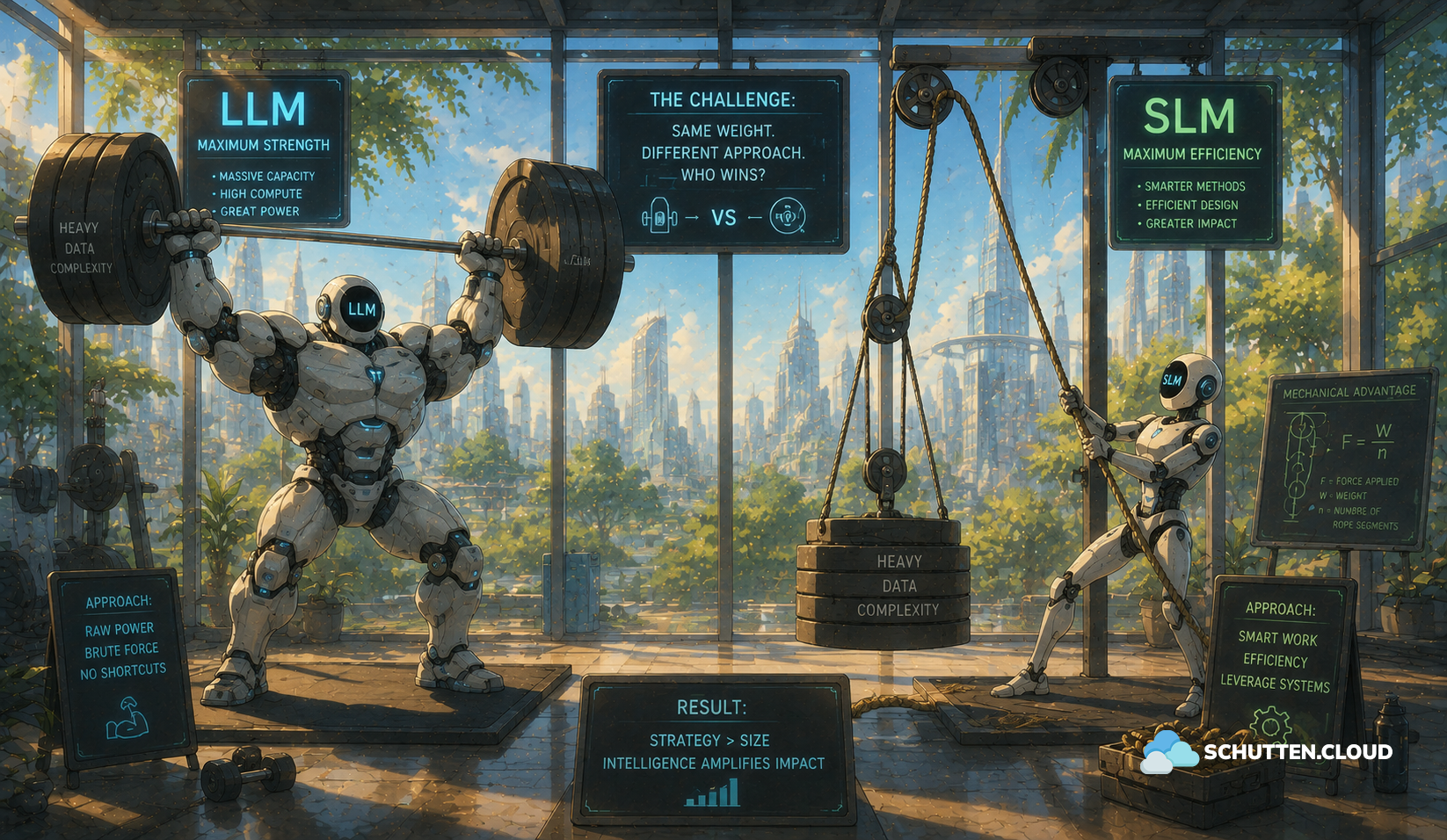
In the early days of generative artificial intelligence, tech companies believed one main rule: bigger is always better. Massive AI models like OpenAI's GPT-4, Google's Gemini Ultra, and Meta's Llama-3 proved that adding hundreds of billions of parameters unlocked incredible skills. These models could solve complex logic problems, write software, and translate languages easily. However, a new trend is taking over the tech world: Small Language Models (SLMs). Models such as Microsoft's Phi-3, Google's Gemma, and Meta's Llama-3-8B show that smaller models can also be smart, fast, and much cheaper to use. To understand the AI landscape today, models are generally divided into three main categories:Large Language Models (LLMs) [70B+ Parameters]: Massive models trained on huge amounts of internet data. They require powerful cloud servers to run and act as general-purpose experts. Medium Language Models [13B to 70B Parameters]: Balanced models that offer strong reasoning skills while still being easier for companies to host privately. Small Language Models (SLMs) [1B to 10B Parameters]: Compact models designed to run efficiently on small hardware, such as regular laptops, smartphones, or small internal company servers.Hardware constraints: Why model size matters To understand why SLMs are becoming so popular, we need to look at computer hardware, specifically graphics memory (VRAM) and speed. Memory requirements (VRAM) To run an AI model, its weights (parameters) must be loaded directly into a computer's high-speed graphics memory.A large 70-billion parameter model needs around 140 GB of VRAM to run at standard quality. This requires high-end enterprise hardware costing tens of thousands of dollars. In contrast, a small 8-billion parameter model can be compressed (quantized) to run using less than 5 GB of VRAM. This means it can easily run on a standard work laptop or a modern smartphone.Speed and latency Big models need to move massive amounts of data back and forth through hardware every time they generate a word. Smaller models carry much less data, which allows them to generate text much faster. This makes SLMs ideal for real-time tasks like live customer chat or typing assistance. How small models get so smart How can a small model perform almost as well as a giant model from a few years ago? The secret lies in high-quality data and smart training techniques. Traditional LLMs learn from raw internet text (billions of webpages, social media posts, and slang). Modern SLMs, on the other hand, learn from curated, high-quality "textbook" data and simplified lessons from larger models.Filtered Synthetic Data: Instead of learning from random internet chatter, modern SLMs are trained on clean, high-quality data created by larger AI models. This includes clear coding examples, textbooks, and step-by-step logic exercises. Knowledge Distillation: This is a process where a large "Teacher" model helps train a smaller "Student" model. The student learns to copy the reasoning patterns of the teacher without needing the giant memory size.Key differences at a glanceFeature Large Language Model (LLM) Small Language Model (SLM)Model Size 70B to 1 Trillion+ parameters 1B to 10B parametersHardware Needed Massive enterprise GPU servers Standard laptops, phones, single GPUsMemory Footprint Very High (100GB+ VRAM) Low (2GB to 10GB VRAM)Response Speed Slower for large answers Extremely fast generationOperating Cost High cloud API or server fees Very cheap to host locallyData Privacy Data usually sent to the cloud Data can stay fully on your local deviceCombining SLMs with company data (RAG) Many organizations assume they need a giant AI model to understand their company's internal files. However, using an AI model as a giant memory bank is inefficient and often leads to false answers (hallucinations). Instead, smart companies combine Small Language Models with a system called Retrieval-Augmented Generation (RAG):Step 1: User asks a question. Step 2: The system searches internal company documents for the facts. Step 3: The exact document text is given to the SLM. Step 4: The SLM reads the text and writes a clear answer.Because the SLM does not need to memorize all company facts inside its parameters, a small 8B model paired with RAG often outperforms a large, expensive LLM at a fraction of the cost. When to choose an LLM vs. an SLM Choosing the right model depends on your specific goals, budget, and privacy requirements. Choose a Large Language Model (LLM) when:You need complex reasoning: Writing complicated software code, analyzing vague legal documents, or solving advanced scientific problems. You build autonomous agents: AI systems that need to plan multiple steps and interact with external tools independently. Your queries are unpredictable: Your application covers many completely different subjects without a fixed focus.Choose a Small Language Model (SLM) when:Speed is critical: Applications like real-time translation, autocomplete, or instant customer support. Privacy is mandatory: Healthcare, finance, or legal tasks where data cannot leave the local building or device. You operate on a budget: Running high volumes of daily requests without paying expensive cloud API subscription fees.Closing thoughts Artificial intelligence is no longer just about building the largest possible model. While giant LLMs remain important for cutting-edge research and complex logic, Small Language Models are proving to be the most practical choice for daily business operations. By using clean training data, clever optimization, and targeted document systems, SLMs deliver fast, private, and cost-effective performance. The best AI architecture is not about using the biggest model available, but finding the smallest model that can solve your problem effectively.

- Rolf Schutten
- 17 Aug, 2026
Why great leadership is about agreements, not expectations
Every morning, millions of professionals wake up and unconsciously ask themselves the exact same question: “What is expected of me today?” They spend the rest of their day trying to satisfy an endless list of imagined demands. What does my boss expect? What does my partner expect? What do my children expect? Trying to guess and fulfill everyone’s hidden expectations is an impossible task. It creates a painful cycle of stress and frustration. Instead of growing into who they could truly be, people get trapped in a passive routine. Unspoken expectations never bring clarity; they only grow bigger, heavier, and more exhausting over time. Why expectations create immature relationships To understand why expectations fail in business, we can look at psychologist Eric Berne’s famous theory of Transactional Analysis. Berne explained that human interactions usually fall into specific roles: Parent, Child, or Adult. Expectation Culture: [Parent Leader] ⟷ [Child Employee] (Control & Frustration) Agreement Culture: [Adult Leader] ⟷ [Adult Employee] (Equality & Ownership)When management relies on vague expectations, it creates an unhealthy Parent-Child dynamic:The Manager acts as the Parent: Trying to micro-manage behaviors, soften every conflict, or act like a caretaker to be liked by everyone. The Employee acts as the Child: Waiting to be told what to do, feeling patronized, and complaining about unclear workload.Many managers make the mistake of practicing "amateur psychotherapy." They focus on controlling the personalities and emotions of their team members rather than building direct working relationships. This caretaking behavior is often just a way to avoid uncomfortable conversations. Real leadership is not about managing feelings; it is about treating people as equals who can take responsibility for their promises. Victims wait, owners agree In his book Conscious Business, leadership expert Fred Kofman highlights the fundamental difference between a Victim mindset and an Owner mindset. Expectations are, by definition, completely passive. When you expect something, you sit back in a false sense of safety, silently hoping someone else will act.The Victim Mindset: Victims prefer expectations because expectations require no courage. A stressed employee sits at their desk silently worrying: "Does my manager really expect this report by Friday? That's impossible, I'm already so overworked!" Instead of speaking up, the victim stays silent, misses the deadline, and blames the system. The Owner Mindset: Owners hate vague expectations. They know that promises require action, clarity, and bold communication. An owner steps forward, opens a direct dialogue, and creates a firm agreement: "I can deliver section A by Friday at 3 PM, but to do that, we need to push project B to next Tuesday. Do we agree?"Making an agreement requires real bravery. You must make clear promises, set measurable goals, and accept total responsibility for the outcome. How to build an agreement-driven workplace Replacing expectations with clear commitments instantly cleans up team communication. When two adults make a voluntary agreement, traditional micro-management becomes obsolete. The leader's role shifts simply to monitoring what was agreed upon. Key Elements of Effective Agreements:Explicit Deadlines and Numbers: Vague statements like "finish this soon" must be replaced with "delivered by Thursday at 12:00 PM." Mutual Input: Agreements are made together. Both parties must freely say "yes" or negotiate better terms before committing. Direct Problem-Solving: When an agreement is broken, you do not judge the person's character; you discuss the facts of the broken promise directly and respectfully.Closing thoughts Leadership is not about carrying the weight of everyone's emotions or expecting people to read your mind. It takes courage to stop guessing, abandon false safety, and start making clear, equal commitments with your team. When you replace passive expectations with active agreements, you build a culture of high performance, deep trust, and mutual respect. True leadership is not about managing personalities or setting vague expectations; it is about making clear agreements as equals and holding each other accountable.

- Rolf Schutten
- 16 Aug, 2026
The AI productivity paradox: Why more tools aren't saving us time
Artificial intelligence has spread faster than almost any other technology in human history. Today, workers across every industry use generative AI daily. They use it for writing reports, designing presentations, writing software, and summarizing long meeting notes. Major software companies have embedded AI directly into our email clients, office suites, and project dashboards. On paper, this should save us hours of work every week. Yet, if you look at modern business statistics, overall productivity has barely moved. Many business leaders are left asking the same frustrating question: If everyone is using AI, why is work not getting done any faster? This situation is not actually new. It is a modern version of the famous "productivity paradox" observed by economist Robert Solow in the 1980s. Back then, he noted that computers were visible everywhere except in the economic productivity numbers. Today, AI faces the exact same challenge. Why AI saves minutes, not whole processes The main reason for this productivity gap is simple: most people use AI to speed up small, isolated tasks rather than fixing full workflows. For example, a customer service agent might use AI to draft a quick reply to an email. The drafting takes five seconds instead of five minutes. However, that message still needs manual review, manager approvals, and input into old database systems. The bottleneck simply moves to another part of the process. In addition, several hidden time-wasters prevent AI from delivering its full potential:The Double-Checking Burden: AI outputs are rarely perfect on the first try. Employees end up spending significant time checking facts, correcting hallucinations, and editing formatting. Tool Overload: Organizations often use multiple specialized AI tools at the same time, such as ChatGPT, Claude, Midjourney, and GitHub Copilot. Deciding which tool to use and switching between them creates mental fatigue. The "More Content" Trap: Because creating documents and emails has become easier, companies generate much more of them. This creates a massive ocean of reports and emails that other employees must spend time reading. Constant Context Switching: Workers constantly jump between Slack messages, email, AI chats, and project boards, which drains mental energy throughout the day.What history teaches us about real efficiency MIT economist Erik Brynjolfsson points out that groundbreaking technologies rarely boost productivity immediately. He compares the current adoption of AI to the arrival of electricity in factories during the late 19th century. When factory owners first replaced steam engines with electric motors, productivity did not go up right away. It was only when they completely redesigned factory layouts and assembly lines around electricity that output exploded. Old Approach: [Standard Process] + [Add AI Tool] = Minimal Time Saved New Approach: [Redesigned Process Built for AI] = Massive EfficiencySimilarly, Wharton professor Ethan Mollick emphasizes that AI works best as a collaborative partner rather than a basic tool. Companies that see massive productivity gains do not just give their workers an AI login; they fundamentally rethink how work gets done. Real-world example: Support & software developmentCustomer Support: Instead of using AI just to suggest email templates, leading companies let AI agents sort tickets, handle routine queries autonomously, and route complex edge cases directly to human experts. Software Engineering: Rather than using AI merely to write single lines of code, teams integrate AI across the whole cycle—from initial architecture planning and automated unit testing to security checks and documentation.Looking ahead: The shift to autonomous agents We are currently moving from simple AI assistants toward autonomous AI agents. New multimodal agentic systems—like Alibaba’s Qwen 3.7 Plus—can look at user interfaces, click buttons, navigate websites, and complete multi-step tasks across different software without constant human prompting. As these tools mature and become affordable to deploy, the central question for businesses will change. It will no longer be "Should we use AI?" but rather "How must we redesign our work to let AI perform whole tasks effectively?" Closing Thoughts Having access to the most powerful AI tools in the world will not automatically make your team faster or smarter. Technology only provides the raw capability; real success depends on how thoughtfully you restructure your daily habits, workflows, and organizational structures to support it. True productivity in the AI era is not about doing old tasks faster. It is about designing completely new ways of working.