The ungoverned cloud: Why cloud strategies fail at execution.
 Rolf Schutten
- 14 Aug, 2026
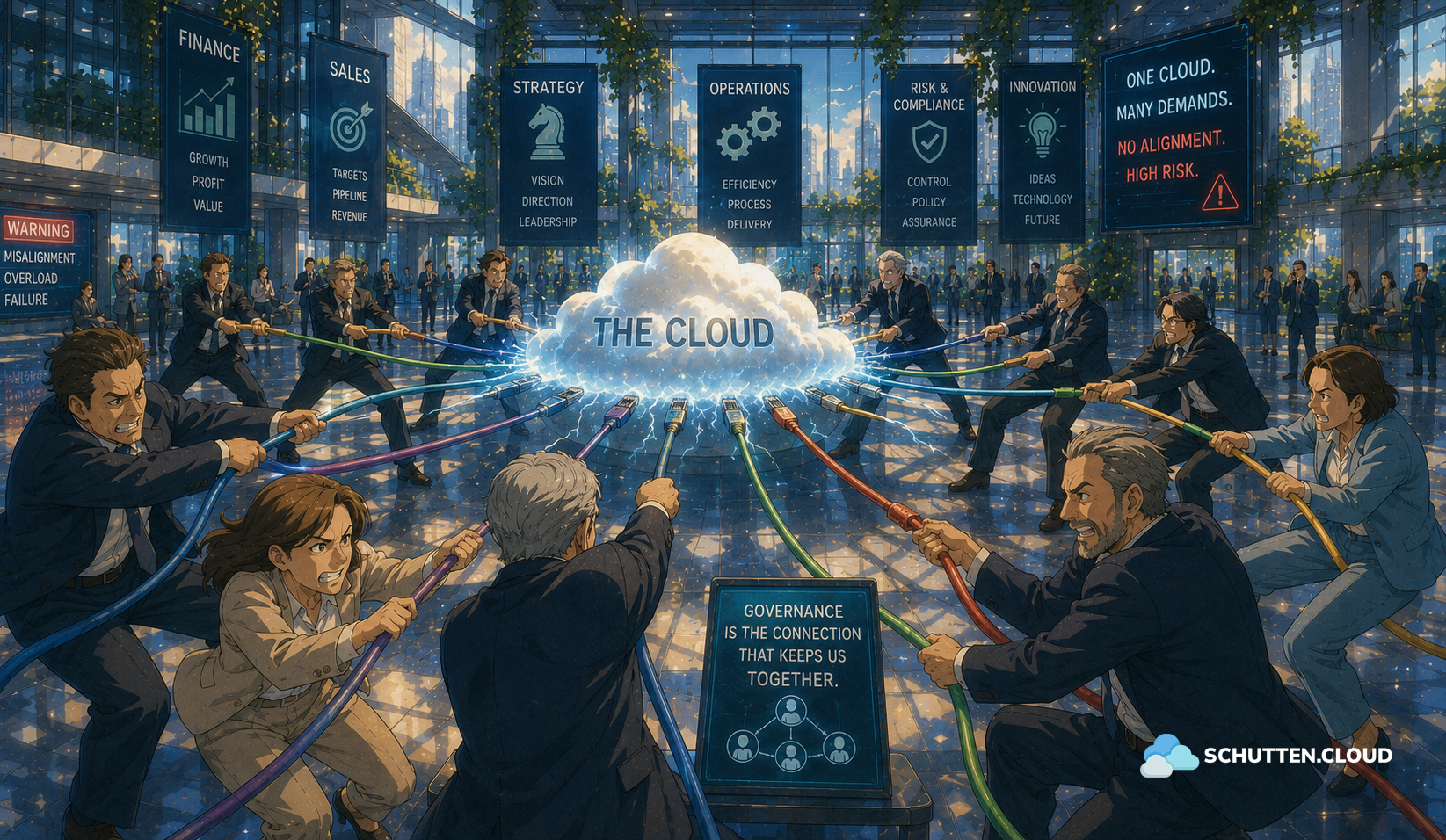
In boardrooms across Europe, cloud strategy is undergoing a harsh reality check. For years, the narrative was centered on speed and migration. Today, executive teams face a very different set of challenges: unpredictable cloud expenditure, strict regulatory mandates (NIS2, BIO2, EU AI Act), and diffuse operational accountability.
When external audits reveal that two-thirds of cloud environments lack proper control, the executive reflex is predictable: install a heavy Governance Board, write 80-page policy manuals, and require manual sign-offs for every change.
This approach fails every time. It creates shadow IT, paralyzes delivery teams, and fails to eliminate actual risk.
Personally, I view cloud governance not as a bureaucratic brake, but as an operational operating system. True governance provides clear guardrails, automated compliance, and organizational clarity—allowing engineering teams to move fast safely.
To achieve this, organizations must move away from theoretical policies and implement a functional Cloud Center of Excellence (CCoE).
The 5 pillars of cloud governance
Before structuring your team, you must define what cloud governance actually encompasses. Mature cloud governance covers five distinct operational domain pillars:
-
Pillar 1: Financial Management (FinOps)
Shifting from static annual IT budgets to dynamic unit economics, continuous cost allocation, and real-time optimization. -
Pillar 2: Security & Regulatory Compliance (NIS2 / BIO2)
Enforcing baseline controls aligned with NIS2, BIO2, ISO 27001, and GDPR across all cloud landing zones. -
Pillar 3: Automation & Platform Engineering
Eliminating manual infrastructure configuration through Infrastructure as Code (IaC) and automated developer platforms. -
Pillar 4: Identity & Data Control (Zero Trust)
Implementing Zero Trust architecture, strict least-privilege principles, and explicit data boundaries. -
Pillar 5: AI & Emerging Tech Governance (ISO/IEC 42001)
Setting parameters for responsible AI use under the EU AI Act and ISO/IEC 42001, preventing unmanaged shadow-AI implementations.
What is expected of C-level leadership?
Cloud governance cannot be delegated away to IT or a compliance team. Real governance requires active C-level involvement, clear sponsorship, and strategic alignment.
Here is what is explicitly expected of executive leadership across each core domain:
| C-Level Role | Core Executive Expectation & Operational Responsibility |
|---|---|
| Chief Executive Officer (CEO) & Board | Treat Cloud Governance as Risk Management: Recognize that cloud failure, data breaches, and non-compliance carry direct board liability under NIS2. Establish risk appetite boundaries and mandate cross-functional governance across the company. |
| Chief Operating Officer (COO) | Align the Operating Model & CCoE Mandate: Provide the CCoE with formal authority to set organizational standards. Break down functional silos between IT, Security, and Business units, ensuring that delivery speed never bypasses compliance. |
| Chief Financial Officer (CFO) | Enforce Financial Accountability (FinOps): Shift financial oversight from traditional CapEx IT depreciation to dynamic OpEx management. Demand unit-cost transparency and require Business/Product Owners to account for cloud consumption within their P&L. |
| Chief Information / Technology Officer (CIO/CTO) | Drive Modern Architecture & Enablement: Transition engineering teams away from manual ticketing towards self-service platforms (IDPs). Enforce “Policy as Code” and ensure cloud infrastructure aligns with architecture goals. |
| Chief Information Security Officer (CISO) | Automate Guardrails Over Gatekeeping: Move from reactive security reviews to proactive, automated policy enforcement. Integrate NIS2, ISO 27001, and AI compliance directly into deployment pipelines. |
Key Leadership Takeaway: Executive leadership is not expected to manage cloud settings or review code. Leadership is expected to set parameters, grant mandate, enforce accountability, and model the culture required for operational discipline.
Enablement, not control
The central execution engine of cloud governance is the Cloud Center of Excellence (CCoE).
Too many companies misinterpret the CCoE as an architectural approval committee that meets every Thursday to review tickets. That is the quickest way to kill organizational momentum.
Gatekeeper vs. Enablement
| Anti-Pattern: The Gatekeeper CCoE | Modern Pattern: The Enablement CCoE |
|---|---|
| Manually reviews and approves architectural change requests. | Builds automated guardrails and self-service templates. |
| Writes static policy PDFs that engineers rarely read. | Embeds policy directly into deployment pipelines (Policy as Code). |
| Acts as a centralized bottleneck for cloud adoption. | Functions as an internal product team serving delivery teams. |
| Measures success by policy compliance and audit logs. | Measures success by engineering velocity, security, and cost efficiency. |
Structure & core roles
A successful CCoE is a lean, cross-functional team that brings together key domains. It does not replace engineering teams; it empowers them.
- Executive Sponsor (COO / VP Operations): Secures budget, aligns governance with corporate P&L goals, and resolves organizational friction between business units.
- Cloud Lead / Architect: Defines overall multi-cloud strategy, Landing Zone standards, and reference architectures.
- Cloud Security & Risk Specialist: Translates regulatory requirements (NIS2, ISO 27001, EU AI Act) into actionable security policies and automated checks.
- Platform Lead / Software Architect: Drives Platform Engineering, building Internal Developer Platforms (IDPs) and self-service “Golden Paths”.
- FinOps Practitioner: Analyzes cloud consumption data, establishes unit-cost metrics, and works directly with product owners on cost accountability.
Practical implementation: A 4-phase roadmap
Implementing cloud governance across an organization requires a phased, practical approach.
Phase 1: Establish the charter & landing zone architecture
- Define the CCoE Charter: Formally declare the team’s purpose, scope, and mandate across the business.
- Build Landing Zones: Create standard multi-account cloud structures (e.g., AWS Organizations or Azure Management Groups). Isolate workloads by environment (Dev, Test, Prod) and business unit.
- Implement Centralized Logging: Ensure audit trails, identity logs, and network traffic are automatically ingested into a central SIEM system from day one.
Phase 2: Automate guardrails (Policy-as-Code)
- Define Preventive & Detective Controls: Use native cloud policies (e.g., Azure Policy, AWS Service Control Policies) to enforce mandatory constraints:
- Preventative: Block public S3 buckets or unencrypted storage volumes from ever being created.
- Detective: Automatically flag and alert security teams when a resource drifts from baseline configuration.
- Tagging Strategy Enforcement: Mandate metadata tags (
Owner,CostCenter,Environment,DataClassification) at deployment time. If a resource lacks tags, auto-remediate or reject the build.
Phase 3: Platform engineering & self-service (Golden Paths)
- Build the Internal Developer Platform (IDP): Provide engineering teams with a self-service portal (e.g., Backstage) to provision compliant infrastructure in minutes.
- Publish Golden Paths: Pre-package approved architectures (e.g., secure microservice deployment, compliant SQL cluster) that include security, monitoring, and backups by default.
- Community of Practice: Establish cloud guilds to train product teams, share best practices, and accelerate internal skills development.
Phase 4: FinOps maturity & Responsible AI governance
- Shift-Left Cost Management: Integrate cost-estimation tools into CI/CD pipelines so developers see the estimated monthly bill before merging code.
- Establish AI Guardrails: Deploy private API endpoints for Generative AI. Ensure corporate data is isolated and protected under strict tenant boundaries.
- Continuous Executive Dashboards: Provide board-level visibility into compliance posture, operational risks, and cloud cost efficiency.
What the board needs to see
To ensure your CCoE is delivering real value, track concrete operational metrics rather than subjective milestones:
| Metric | Target / Good Practice | Executive Focus |
|---|---|---|
| Landing Zone Coverage | > 95% of workloads in governed Landing Zones | Risk & Compliance |
| Untagged Cloud Resources | < 2% of total cloud assets | Financial Accountability |
| Policy Drift MTTR | < 4 hours to remediate non-compliant resources | NIS2 / Security Posture |
| Golden Path Adoption | > 80% of new microservices deployed via IDP | Velocity & Standardization |
| Cloud Unit Cost | Decreasing cost per business transaction | P&L & Scalability |
Closing thoughts
Solving cloud governance is not a technical problem; it is an organizational design challenge.
Relying on manual audits, reactive firefighting, and bureaucratic approvals inevitably leads to higher costs and increased business risk. True operational leadership means building a system where compliance, security, and cost control are automated and frictionless.
By establishing a modern Cloud Center of Excellence, embedding Policy as Code, and adopting Platform Engineering, executive teams can bridge the gap between high-level strategy and ground-level execution.
When governance is built directly into your operating model, compliance stops being a burden—it becomes a competitive advantage that enables rapid, resilient, and profitable growth.